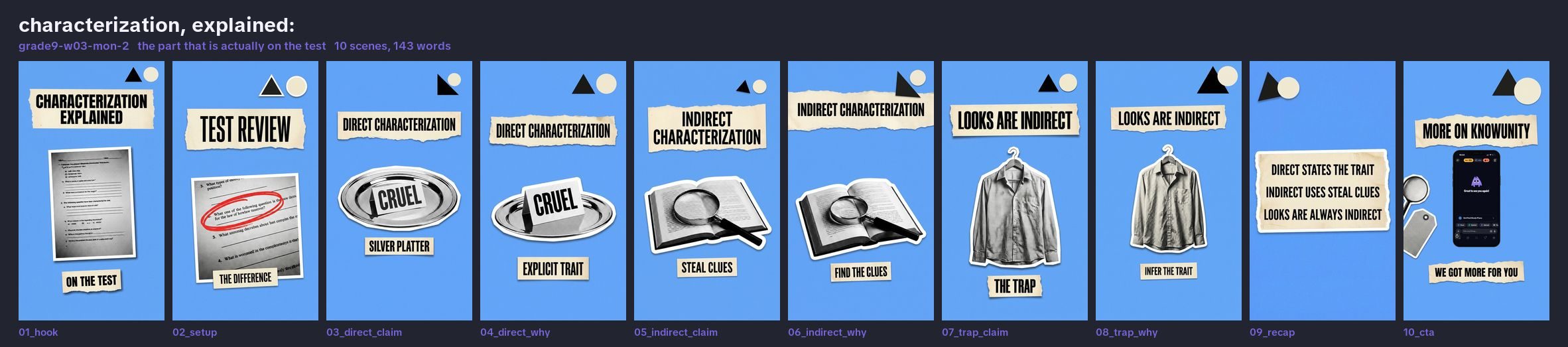
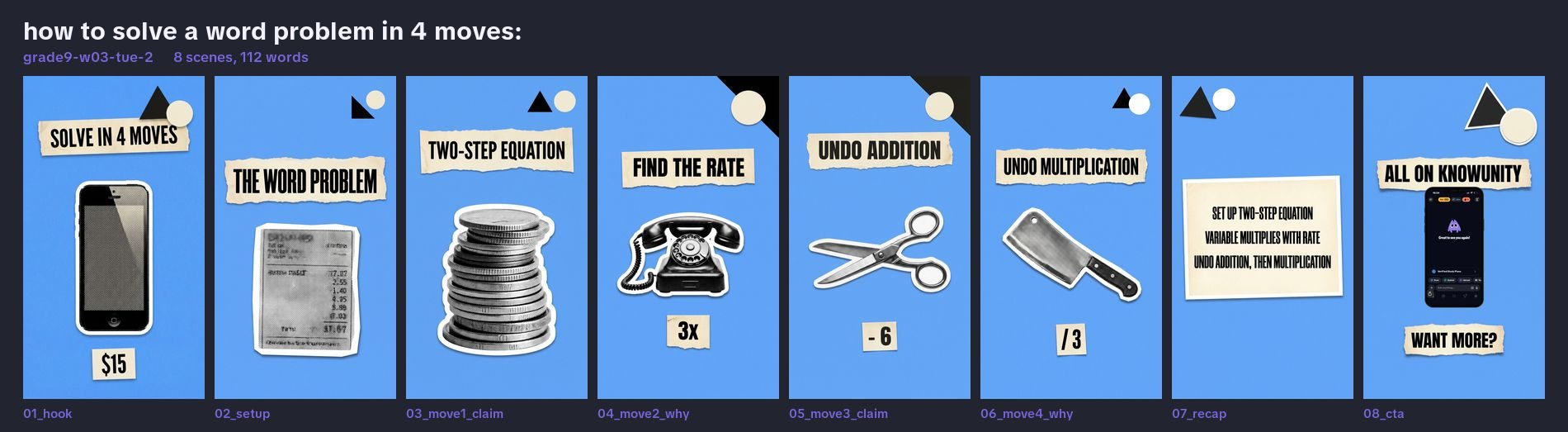
Polished
concept, applicationBeige paper, Greed Bold Italic headline in the subject colour, handwriting body, merged highlighter marks.


Knowunity · US content machine · the main artifact
Structure - how content gets made, as a map and as text; Calendar - all 17 account calendars, week by week; Styles - 16 styles in six groups, colours, CTA and per-account assignment; Accounts - TikTok links and live performance from TokPortal; W1 Batch - the rendered week-1 posts, per account; W2 Batch - every week-2 deck as it stands.
The same machine in prose - thesis first, then each part in depth.
We post what a specific student is struggling with right now, every post is backed by verified, test-level substance, and the production machine is structured so that quality is a property of the system, not of anyone's discipline on a given day. Three parts follow from this: knowing the student and their moment, defining what quality actually means, and building the machine that produces it at scale.
The premise underneath everything: the students we want are the ones studying for a test this week. They can tell a real insight from filler in two slides, and they punish fake substance in the comments. So the bar is not "correct enough for social media" — it is the question on the unit test, verified before any human even reviews it. Depth over speed, always: never the easiest, quickest answer — the real sources, the real misconception, the real mechanism.
Every account belongs to one of three baskets, and each basket has a different clock.
The official College Board CED is a national syllabus: numbered topics, exam weightings, one national exam date. So AP ideas are never brainstormed — they are scheduled. The 16-week fall calendar maps every week to its CED unit in order; we can say "you are in Period 1 right now" and be right for most viewers. The fixed moments are layered on top: registration deadlines, the November 13 ordering deadline, finals. All eleven CED PDFs are downloaded into the repo; curriculum claims trace to those PDFs, never to memory.
Algebra 1, Geometry, Chemistry, Biology, English. No national syllabus, so the course order has to come from somewhere real, and we only claim what we can actually check: published textbook sequences and pacing guides establish the conventional order (linear → systems → quadratics), verified against the actual tables of contents whenever we rely on them — and our own app data confirms or corrects it, because what Algebra 1 students search in Knowunity week by week shows where classes actually are. Calendars drift three to four weeks between schools, so we target the unit with a wide window ("if you are in factoring right now, here is what trips everyone") and carry a heavier evergreen share. Khan/Knowt give the shape and difficulty of questions, always re-authored with our own numbers in our own renderer.
The demand source is our own app — and the funnel is live. The first report (Sep 1) measured ~912,000 academic AI-chat questions from ~33,000 US grade 9–12 students in 14 days: Algebra 1 is the single biggest subject (46k questions), with Biology, Geometry, Algebra 2, US History, English, and Chemistry all top-10 — the account lineup validated by demand, not assumption. One honest nuance the data forced: US students barely use in-app content search (40 searches in the window vs ~90,000 in Germany), so the AI chat is the US signal, not search. The report reruns weekly from a documented query (input/demand/); nothing is cited that we do not have a real funnel for.
Grade 9, 10, 11. The account is a course bundle, and the rotation is deliberately simple: today math, tomorrow biology, the day after English — each course in the bundle takes its turn across the week. Within each course, basket-2 logic decides the position: an Algebra 1 slot in October is not on linear anymore, it is on systems or quadratics. On top of that sits the life calendar — first unit tests, GPA moments, finals. Grade 11 is the SAT-and-AP year and sounds like it.
Why imperfect timing is good enough: the algorithm and search do the per-viewer matching — timing raises the base rate, labeling posts with the exact strings students search does the targeting, and comments tell us whether an account runs ahead or behind. And Knowunity's own usage data is an empirical national syllabus: what US students search in the app, week by week, measures the school year instead of guessing it. Every account gets a written avatar — one specific student, not a demographic — and the avatar decides tone, difficulty, and which moments matter. The avatar is internal only: it is the reader we write FOR, never a character the account plays. Accounts never look like creator accounts — no persona, no face, no first-person “my” voice; they stay clean study resources.
Every post is one of three types: concept (teach it), application (use it), practice (test yourself). The weekly formula per account is fixed and essential: 2 concept + 2 application + 3 practice — seven posts, Monday through Sunday. The bar every post clears:
Consequence: difficulty decides the format, never the reverse. A question with a real trap earns the worked-solution deck; an easy question is at most a warm-up rung. And the trap is not decoration — it becomes the hook, the crossed-out wrong answer on the slide, and the reason the post gets argued about.
Nothing moves to a later step before the earlier step is filled and reviewed. The machine lives in projects/julian_ap_content (steps 1–3) and projects/julian_carousel + julian_tokportal (steps 4–5).
One JSON per account: 16 weeks (Aug 31 – Dec 20), 7 posts per week with day, date, type, topic code, and an atomic angle as the title. Seventeen accounts × 16 weeks × 7 posts = 1,904 planned posts. Binding authoring rules: atomic titles, test-anchored angles, practice titles hint the trap, specific beats clever, stay inside the week's topic range.
Three rules: niche down (one atomic thing per post, in depth), prove it (every claim sourced, every answer blind-verified), match the test (real difficulty, one documented trap, laddered).
The verified substance. One unit per distinct topic code in the calendar week (the scaffold is calendar-driven, so every post has substance behind it). Each unit carries: a one-sentence brief (one CED objective), facts cited to specific CED codes, an original explanation of the mechanism, a worked example, three documented misconceptions, and the practice ladder — where every question must name its trap (the specific shortcut and the plausible wrong answer it produces), its anchor (the CED code or released question that calibrates it), and its rung.
Then the step that makes the whole thesis real: blind verification. A second, independent pass solves every question seeing only the question — no answer key. Math is computed, never estimated. A mismatch bounces the unit back with a note, and the incident becomes a permanent rule in drafting_rules.md. In week 1 this caught a real arithmetic error (a 26 that was actually 34) before any human saw it. One pipeline truth from that week: every numeric total is computed in Python, and exam-structure numbers are read from the CED table, never from memory.
Sourcing is binding: the CED is the spine, original prose only, OpenStax CC BY permitted with attribution, Khan Academy remix prohibited on AP. Maths problems and plain facts are free to use; authored prose and diagrams get rewritten and redrawn. Sources exist for answer and terminology verification. No trademark disclaimer on posts or bios.
The link between planning and production: one post spec per calendar row, joining the backing unit, the hook (drafted here, per the canon below — never invented at render time), and the style. A validator enforces the hard rules mechanically: no unit, no post; nothing renders on unverified answers; hook rotation is bookkept (never the same template twice in a row, three distinct challenge templates across a week's practice posts); and the promise contract — the deck owes what the hook promises ("3 questions" means exactly three, "cheat sheet included" means one screenshot-able slide, "swipe for the solution" means it is the next slide).
Slides are drawn by code, not generated: Python renderers set the type, highlights, arrows, and diagrams pixel-precisely. AI image generation appears only where code cannot draw — organic plates (a cell, a brain, a map) through the approved style kit, with every label verified before shipping. Practice and worked decks are template-consumable; concept decks carry bespoke diagrams, which is where the craft budget goes. Everything renders from approved units only — nothing is written at render time.
TokPortal schedules the rendered decks against the calendar dates, logging each post's hook template so performance reads out per family and template. Captions, hashtags, and sounds are a later layer by explicit decision, as is the account wiring (handles, bundles, the HS→AP repositioning of bio.knowie and chem.rescue).
The loops close the system: comments calibrate timing, solve rates calibrate difficulty, post performance feeds repost slots and hook-template weights, and every rejection reason becomes a drafting rule. Year two starts with the library built — packs, units, templates all compound.
The hook is the viral mechanism, and it has one core principle: it talks TO the viewer — dares them, promises them, warns them. A hook that merely describes the topic is banned. The canon was mined from every hook we have ever shipped; these five families are the only hooks used, on any account, in any pipeline (HOOKS.md holds the templates and the full verbatim bank):
| Family | Voice | Serves |
|---|---|---|
| 1 · Challenge | "Can you solve this in 10 seconds?" · "can you still solve freshman algebra?" · "the impossible triangle question" | practice — the highest converter |
| 2 · Social proof | "most freshmen can't explain this" · "90% of students get it wrong" · "most people miss the last one" | practice headlines and sub-lines |
| 3 · Cheat sheet | "everything you need to know before your first test: cheat sheet included" · "X, explained:" · "guaranteed question on every chem test:" | concept — the save driver |
| 4 · How-to | "how to write a thesis in one sentence:" · "steal this" · "how to guarantee points on the DBQ" | application |
| 5 · Personal curiosity | "DNA and RNA are not the same — do you know why?" · "3 things no one tells you about X" | the variety slot |
Styles are chosen last: the account decides whether the deck is branded, the post type decides the pool, and a deterministic draw per post picks a group first, then a variant inside it, so a week spreads across looks. Every style lives in one shared renderer (projects/carousel/styles.py) and takes the account colour from the registry. The full library, with rendered examples, is on the Styles tab.
Invariants: one deck one style, never the same group on two consecutive posts of an account, ten slides maximum, and every deck carries a one-sentence CTA. Branded = the .knowie accounts; everything else carries only the small by knowunity mark. Every colour is a Knowunity design token.
Julian's review is the only judgment layer left, and the machine is built to keep it cheap: one line per question (question · answer · trap · anchor), the hooks reviewed alongside, approve or reject with a reason — and the reason becomes a drafting rule that binds every later batch. Nothing is "approved" until Julian says so after seeing it. At full scale (17 accounts, ~120 posts a week) review shifts to approve-by-exception: flagged items and samples, not everything.
As of September 1: the calendars exist for all 17 accounts; week-1 content for the four active AP accounts (APUSH, Psych, Bio, Chem) is drafted and blind-verified — 35 of 36 answers matched on the first pass, one arithmetic error caught and fixed; the posts layer and validator are live across all 16 weeks; the hook canon and style atlas are published; seven demo decks exist in the polished/quiz styles with canon hooks. Deliberately deferred: captions/hashtags/sounds, account wiring, the Sunday-review question selection, and the style matrix — each waiting on its own decision, none blocking the next batch.
Every planned post: day, type (2 concept + 2 application + 3 practice), topic code, and the atomic angle.
Every style lives in projects/carousel/styles.py and takes the account colour from the registry, so the same style reads green on Biology and blue on Chemistry. Groups: Notes, Paper, Photo, Dark, Clean, Paper Snapshot.
Binding rules. Canvas 1080×1440 (bio-notes square is the 1:1 exception). Hooks come only from the HOOKS.md canon. Weekly mix 2 concept + 2 application + 3 practice. Every deck ends with a CTA slide, exactly one sentence. Branded = the .knowie accounts (six today); everything else carries only the small by knowunity mark, Blackbox and Paper Snapshot included. Every colour is a Knowunity token. Knowie is flat, never reshaped, no shadow, no outline.
coral.bold #FB7E5Bbrand.bold #9178E6green.bold #00C386blue.bold #5FA0FCgreen.onSubtle #4AE5B0coral.onSubtle #FFB59Bmagenta.bold #E879C0magenta.onSubtle #F7B5DEbrand.onSubtle #7B65E0brand.onSubtle #7B65E0brand.onSubtle #7B65E0Julian, 2026-09-22: 16 styles in six groups; the draw runs over the groups so a week spreads across looks. Rendered examples are the ones this page already had (Biology green, then Chemistry blue); three newer styles are listed without a render.
One of the six groups; the weekly draw picks the group first, then a variant inside it. Never the same group on two consecutive posts of an account.
Beige paper, Greed Bold Italic headline in the subject colour, handwriting body, merged highlighter marks.
Text on top, a relevant DRAWN graphic below. The graphic is the point.


The handwritten notes look, square composition, ruled feel, highlighter.


One of the six groups; the weekly draw picks the group first, then a variant inside it. Never the same group on two consecutive posts of an account.
Paper ground, ink-pen linework and lettering; the ink takes the subject colour.


Photo of notes, question set typeset over it.


Photograph of a real sheet on a desk, the handwriting drawn inside that sheet in the account's pen colour; the sheet changes on every slide. Added 2026-09, no render on this page yet.
One of the six groups; the weekly draw picks the group first, then a variant inside it. Never the same group on two consecutive posts of an account.
Real photo plate, white translucent panel carrying the text.


Study-scene background, text set in solid pill blocks.


Portrait from the v2 library, text over the calm dark top third.


One of the six groups; the weekly draw picks the group first, then a variant inside it. Never the same group on two consecutive posts of an account.
Black ground, white rounded card holding the text. Always branded.


Flat dark ground, text directly on it, no card.


Knowie peeks in from the side. Main text ALWAYS centred.


One of the six groups; the weekly draw picks the group first, then a variant inside it. Never the same group on two consecutive posts of an account.
White practice deck, numbered question cards.


Worked solution, one move per step, cumulative.


Black and white only: white ground, black headline, one grey, a black block carrying the eyebrow. No account colour anywhere. Added 2026-09-11, no render on this page yet.
One of the six groups; the weekly draw picks the group first, then a variant inside it. Never the same group on two consecutive posts of an account.
Every slide is one generated photograph with the handwriting already in it; every slide proofread. Added 2026-09, no render on this page yet.
The drawn primitives the Sketch-light style composes from. All code-drawn, all take the subject colour. A photo may never stand in for one.


Every deck ends with one of these. One sentence, never stacked.


| account | concept ×2 | application ×2 | practice ×3 |
|---|---|---|---|
| APUSH | Sketch-light ×2 | Celebrity, Pill | Celebrity, Ink-on-paper, Blackbox* |
| AP Psych | Side-peek, Polished | Side-peek, Ink-on-paper | Paper-note quiz, Pill, Blackbox* |
| AP Bio | Polished ×2 | Ink-on-paper, Pill | Pill, Blackbox ×2 |
| AP Chem | Photo b-roll, Bio-notes sq | Photo b-roll, Bio-notes sq | Blackbox, Pill, Photo b-roll |
| AP HuG | Polished ×2 | Ink-on-paper, Sketch-light | Blackbox ×2, Pill |
| Algebra 1 | Paper-note quiz, Polished | Side-peek ×2 | Blackbox ×2, Math solution |
| Geometry | pending | pending | pending |
| English | Bio-notes sq, Sketch-light | Polished, Bio-notes sq | Pill, Blackbox, Pill |
| Grade 9 | Sketch-light ×2 | Pill ×2 | Quiz white, Pill, Blackbox |
| Grade 10 | Pill, Sketch-light | Polished, Ink-on-paper | Paper-note quiz, Pill, Solid dark |
| Grade 11 | Paper-note quiz, Sketch-light | Polished, Pill | Blackbox ×2, Paper-note quiz |
* filled in by Claude because only two of the three practice styles were named - not yet Julian's decision.
Every account with its TikTok link, current performance, and the last five tracked posts with real view counts. The scrape timestamp is on each card.
Weeks run Monday to Sunday. Views are the daily account views TikTok reports through TokPortal, summed across all accounts; TikTok reports each day about a day late, so the current week fills in as it goes. Engagement is likes + saves + comments to date on the posts published that week.
All posts, all accounts, updated 2026-09-23 07:00 UTC
Likes, saves and comments on the week's posts
Best posts so far
The five highest-viewed posts across all 15 accounts, out of 176 tracked. Slide 1 as it was posted. Updated 2026-09-23 07:00 UTC.
11,007 views
Grade 11 Physics: How to Pick the Right Kinematic Equation The four c
885 likes · 618 saves
open ↗ #3
#38,181 views
"5 less than a number" is n - 5, not 5 - n. the phrase names what you take away first
50 likes · 8 saves
open ↗6,270 views
AP Biology Unit 1.6: DNA vs RNA, Nucleotide Structure and the Three Di
300 likes · 187 saves
open ↗Network totals (TokPortal analytics, 15 tracked accounts, updated 2026-09-23 07:00 UTC): 159,637 views · 6,655 likes · 2,622 saves · 289 followers · 176 posts tracked · best post 13,413 views · avg 962 views/post
| account | handle | followers | posts | views | avg/post | likes | saves |
|---|---|---|---|---|---|---|---|
| Algebra Knowie | @algebra.knowie | 109 | 21 | 34,980 | 1,666 | 968 | 384 |
| Grade 11 rescue | @grade11.rescue | 15 | 17 | 22,408 | 1,318 | 1,325 | 728 |
| Chemistry rescue currently banned | @chem.rescue | 0 | 18 | 21,252 | 1,181 | 951 | 405 |
| Knowie explains Bio | @bio.knowie | 36 | 20 | 20,729 | 1,036 | 974 | 411 |
| AP HuG Knowie | @aphug.knowie | 61 | 15 | 13,178 | 878 | 513 | 235 |
| Grade 10 Rescue | @grade10.rescue | 17 | 17 | 12,610 | 742 | 595 | 149 |
| The English Explainer | @english.explainer1 | 17 | 17 | 9,264 | 545 | 558 | 132 |
| Grade 9 Knowie | @grade9.knowie | 2 | 3 | 8,590 | 2,863 | 62 | 8 |
| Geometry AP - Help | @geometry.ap.expla | 15 | 13 | 7,747 | 596 | 331 | 104 |
| AP Psych x Knowie | @appsych.knowie | 7 | 15 | 6,597 | 440 | 299 | 44 |
| APUSH Knowie | @apush.knowie | 9 | 3 | 2,210 | 737 | 77 | 22 |
Algebra simply explained 🧮🧠📚
updated 2026-09-23 07:00 UTC
| date | all 21 posts | views | likes | saves | link |
|---|---|---|---|---|---|
| 2026-09-22 | Algebra 1: Simplifying Expressions with Double Distribution Simplify 4(2x - 3) | 0 | 0 | 0 | open ↗ |
| 2026-09-18 | Algebra 1: Solving Multi-Step Equations with Parentheses on Both Sides How to s | 2,192 | 81 | 23 | open ↗ |
| 2026-09-17 | Algebra 1: Properties of Operations (Commutative, Associative, Identity, Inverse | 1,130 | 63 | 37 | open ↗ |
| 2026-09-16 | Algebra 1: Distributing a Negative Sign Rewrite -(x - 3) without parentheses. M | 1,197 | 20 | 7 | open ↗ |
| 2026-09-15 | Algebra 1: Terms, Coefficients and Constants Simplify 7x - 2x + 4 is asking you | 1,002 | 80 | 23 | open ↗ |
| 2026-09-14 | Algebra 1: Order of Operations PEMDAS is not six steps, it is four precedence l | 1,705 | 73 | 26 | open ↗ |
| 2026-09-13 | Algebra 1 Week 1 Review: Order of Operations, Evaluating Expressions, Combining | 1,634 | 115 | 37 | open ↗ |
| 2026-09-12 | Algebra 1: Combining Like Terms with Exponents Five Algebra 1 practice problems | 463 | 10 | 4 | open ↗ |
| 2026-09-11 | Algebra 1: Translating Words into Expressions Five less than twice a number is | 1,147 | 43 | 21 | open ↗ |
| 2026-09-10 | Algebra 1: The Negative Exponent Trap -3^2 and (-3)^2 are different numbers, an | 567 | 7 | 2 | open ↗ |
| 2026-09-09 | Algebra 1: Evaluating Expressions with Negatives Evaluating 3x^2 - 2(x - 5) at | 921 | 38 | 14 | open ↗ |
| 2026-09-05 | the one formula you actually have to memorize Part 8 #algebra #math #mathhelp | 1,571 | 57 | 20 | open ↗ |
| 2026-09-05 | simplifying the scariest exponent problem step by step Part 9 #algebra #math #ex | 995 | 40 | 15 | open ↗ |
| 2026-09-05 | the 3 line formulas you need for Algebra 1 Part 10 #algebra #math #mathhelp | 2,713 | 118 | 108 | open ↗ |
| 2026-09-02 | the one formula you actually have to memorize Part 8 #algebra #math #mathhelp | 13,413 | 150 | 40 | open ↗ |
| 2026-09-02 | life when the quiz starts with a free question Part 6 #algebra #math #quiz | 2,074 | 31 | 1 | open ↗ |
| 2026-08-27 | y = mx + b cheat sheet (the core) Part 3 #algebra #math #mathhelp | 111 | 0 | 0 | open ↗ |
| 2026-08-26 | top 3 hardest Algebra 1 questions - how many can you solve? Part 2 #algebra #mat | 28 | 0 | 0 | open ↗ |
| 2026-08-25 | algebra tricks that genuinely save me time Part 5 #algebra #math #mathhelp | 41 | 0 | 0 | open ↗ |
| 2026-08-24 | the hardest question on the Algebra 1 final Part 4 #algebra #math #quiz | 2,062 | 42 | 6 | open ↗ |
| 2026-08-23 | Algebra simply explained Helping you with Algebra Part 1 #algebra #math #mathhe | 14 | 0 | 0 | open ↗ |
Helping you survive 11th Grade
updated 2026-09-23 07:00 UTC
| date | all 17 posts | views | likes | saves | link |
|---|---|---|---|---|---|
| 2026-09-22 | Grade 11 Algebra 2 and Physics: Can You Survive as an 11th Grader Quiz Four mul | 0 | 0 | 0 | open ↗ |
| 2026-09-17 | Grade 11 Physics: How to Pick the Right Kinematic Equation The four constant-ac | 11,007 | 885 | 618 | open ↗ |
| 2026-09-16 | Grade 11 Algebra 2: Factoring or the Quadratic Formula, the Discriminant Decides | 585 | 34 | 9 | open ↗ |
| 2026-09-14 | Grade 11 US History: The 13 Colonies Cheat Sheet, New England, Middle and Southe | 1,398 | 122 | 33 | open ↗ |
| 2026-09-13 | Grade 11 English: Puritan Plain Style in Anne Bradstreet's Verses upon the Burni | 332 | 1 | 0 | open ↗ |
| 2026-09-10 | Junior Week 1 Review Quiz: Function Notation, Speed vs Velocity, Jamestown vs Pl | 753 | 36 | 4 | open ↗ |
| 2026-09-09 | English 11: The Crucible Act 1, Who Accuses Whom and Why Six motive checks on T | 315 | 8 | 0 | open ↗ |
| 2026-09-07 | Grade 11 US History: Jamestown vs Plymouth Jamestown and Plymouth were founded | 174 | 3 | 1 | open ↗ |
| 2026-09-06 | Grade 11: Why Junior Year Is the Transcript Year Junior year is the transcript | 1,315 | 20 | 6 | open ↗ |
| 2026-09-05 | Grade 11 Algebra 2: Composing Functions Six problems where the order in f(g(x)) | 11 | 0 | 0 | open ↗ |
| 2026-09-04 | Grade 11 Physics: Speed vs Velocity Speed and velocity are not synonyms, and ph | 930 | 50 | 27 | open ↗ |
| 2026-09-03 | Grade 11 Algebra 2: Function Notation f(x + 2) and f(x) + 2 are different moves | 618 | 34 | 8 | open ↗ |
| 2026-08-26 | proven tips to survive junior year Part 2 #junioryear #highschool #sat | 1,115 | 23 | 7 | open ↗ |
| 2026-08-25 | Junior year simply explained Helping you survive Grade 11 Part 1 #highschool #j | 1,117 | 22 | 5 | open ↗ |
| 2026-08-24 | can you still solve sophomore math? Part 5 #math #junioryear #quiz | 1,216 | 30 | 4 | open ↗ |
| 2026-08-23 | the GPA colleges actually look at Part 4 #junioryear #gpa #collegeprep | 1,369 | 52 | 6 | open ↗ |
| 2026-08-22 | surviving the hardest year of high school Part 3 #junioryear #highschool #studyt | 153 | 5 | 0 | open ↗ |
stoich shouldn't hurt ⚗️ one chem concept a day, 60 seconds each
updated 2026-09-23 07:00 UTC
| date | all 18 posts | views | likes | saves | link |
|---|---|---|---|---|---|
| 2026-09-17 | AP Chemistry Unit 1.7: Ranking Ionic Radius and Ionization Energy Top 3 hardest | 0 | 0 | 0 | open ↗ |
| 2026-09-16 | AP Chemistry Unit 1.5-1.8: Can You Survive as an AP Chem Student Quiz Three AP | 0 | 0 | 0 | open ↗ |
| 2026-09-15 | AP Chemistry Unit 1.7: Successive Ionization Energies and Finding the Group How | 0 | 0 | 0 | open ↗ |
| 2026-09-14 | AP Chemistry Unit 1.5: Coulomb's Law and Effective Nuclear Charge The Coulomb's | 0 | 0 | 0 | open ↗ |
| 2026-09-13 | AP Chemistry Unit 1.8: Valence Electrons, Ionic Charge and Why Al2O3 Why alumin | 0 | 0 | 0 | open ↗ |
| 2026-09-12 | AP Chemistry Unit 1.7: Periodic Trends, Atomic Radius and Ionization Energy Ever | 1,315 | 41 | 41 | open ↗ |
| 2026-09-10 | AP Chemistry Unit 1 Review Quiz: Moles, Molar Mass, Percent Composition and Mass | 2,003 | 38 | 21 | open ↗ |
| 2026-09-10 | AP Chemistry Unit 1.2: Mass Spectrometry, Isotopes and Average Atomic Mass Three | 923 | 33 | 12 | open ↗ |
| 2026-09-08 | AP Chemistry Unit 1.3: Percent Composition to Empirical Formula Percent composit | 1,453 | 82 | 45 | open ↗ |
| 2026-09-07 | AP Chemistry Unit 1.3: Percent Composition Every sample of a pure compound keeps | 1,151 | 75 | 18 | open ↗ |
| 2026-09-05 | AP Chemistry Unit 1.1: Molar Mass Practice Five molar mass conversions where the | 1,147 | 33 | 5 | open ↗ |
| 2026-09-05 | AP Chemistry Unit 1.1: Grams to Moles to Particles The mole is the bridge betwee | 1,163 | 50 | 29 | open ↗ |
| 2026-09-04 | AP Chemistry Exam Format: 9 Units and the Equation Sheet Two published tables te | 1,901 | 80 | 24 | open ↗ |
| 2026-08-27 | periodic table hacks that genuinely save me time Part 2 #chemistry #chemhelp #st | 4,011 | 310 | 178 | open ↗ |
| 2026-08-25 | can you name all 4 compounds? Part 5 #chemistry #quiz #apchem | 1,572 | 60 | 4 | open ↗ |
| 2026-08-25 | do you know those elements? Part 4 #chemistry #quiz #chemhelp | 1,040 | 16 | 2 | open ↗ |
| 2026-08-23 | guaranteed question on every chem test Part 3 #chemistry #apchem #chemhelp | 2,340 | 76 | 19 | open ↗ |
| 2026-08-23 | Chemistry simply explained Helping you with Chemistry Part 1 #chemistry #apchem | 1,233 | 57 | 7 | open ↗ |
Knowie explaining Biology (easy, dw)
updated 2026-09-23 07:00 UTC
| date | all 20 posts | views | likes | saves | link |
|---|---|---|---|---|---|
| 2026-09-22 | AP Biology Unit 1.3: Dehydration Synthesis, One Water per Bond Dehydration synt | 0 | 0 | 0 | open ↗ |
| 2026-09-20 | AP Biology Unit 1.7: Four Levels of Protein Structure and Tertiary Interactions | 1,135 | 40 | 35 | open ↗ |
| 2026-09-18 | AP Biology Unit 1.6: DNA vs RNA, Nucleotide Structure and the Three Differences | 6,270 | 300 | 187 | open ↗ |
| 2026-09-17 | AP Biology Unit 1 Review Quiz: Properties of Water and Macromolecules (1.1-1.4) | 780 | 26 | 7 | open ↗ |
| 2026-09-16 | AP Biology Unit 1.3: Hydrolysis of Polymers, Monomers and Polysaccharides One AP | 487 | 10 | 3 | open ↗ |
| 2026-09-16 | AP Biology Unit 1.5: Lipids, Saturated vs Unsaturated Fatty Acid Tails Why one l | 431 | 18 | 5 | open ↗ |
| 2026-09-14 | AP Biology Unit 1.3: Dehydration Synthesis and Hydrolysis Dehydration synthesis | 901 | 29 | 11 | open ↗ |
| 2026-09-14 | AP Biology Unit 1.1: Water and Hydrogen Bonding One structural fact earns water | 890 | 47 | 29 | open ↗ |
| 2026-09-13 | AP Biology Unit 1.1: Cohesion, Adhesion and Surface Tension Cohesion, adhesion o | 776 | 25 | 6 | open ↗ |
| 2026-09-11 | AP Biology Unit 1.1: Why Ice Floats Why ice floats is a hydrogen bonding questio | 1,376 | 77 | 18 | open ↗ |
| 2026-09-10 | AP Biology Exam Format: 8 Units and 6 Science Practices AP Biology is not a memo | 2,136 | 96 | 37 | open ↗ |
| 2026-09-04 | meiosis explained in handwritten notes Part 9 #biology #apbio #meiosis | 849 | 44 | 14 | open ↗ |
| 2026-09-03 | revising the wrong kind of biology Part 8 #biology #school #studytok | 762 | 28 | 1 | open ↗ |
| 2026-09-02 | my whole schedule is just biology Part 7 #biology #school #studytok | 773 | 32 | 0 | open ↗ |
| 2026-09-02 | the basics of 9th grade Biology in handwritten notes Part 6 #biology #science #s | 1,653 | 134 | 40 | open ↗ |
| 2026-08-28 | Biology notes you may need: the cell Part 2 #biology #apbio #science | 1,148 | 62 | 18 | open ↗ |
| 2026-08-25 | guaranteed test question: mitosis vs meiosis Part 5 #biology #apbio #mitosis | 7 | 0 | 0 | open ↗ |
| 2026-08-24 | DNA to protein, the central dogma Part 4 #biology #apbio #dna | 89 | 1 | 0 | open ↗ |
| 2026-08-24 | photosynthesis and respiration, the energy cycle Part 3 #biology #apbio #science | 101 | 1 | 0 | open ↗ |
| 2026-08-23 | Biology simply explained Helping you with Biology Part 1 #biology #apbio #scienc | 165 | 4 | 0 | open ↗ |
Struggling with AP HuG? thats why I exist 🌍🗺️🧠
updated 2026-09-23 07:00 UTC
| date | all 15 posts | views | likes | saves | link |
|---|---|---|---|---|---|
| 2026-09-22 | AP Human Geography Unit 1.7: Formal, Functional or Perceptual Region Quiz Forma | 0 | 0 | 0 | open ↗ |
| 2026-09-18 | AP Human Geography: Arithmetic, Physiological and Agricultural Density Practice | 357 | 6 | 2 | open ↗ |
| 2026-09-17 | AP Human Geography Unit 1.6: Scale of Analysis FRQ Traps, Spot the Mistake Can y | 457 | 13 | 4 | open ↗ |
| 2026-09-16 | AP Human Geography Unit 1 Survival Quiz: Distance Decay, Relative Distance, Clus | 2,398 | 40 | 14 | open ↗ |
| 2026-09-15 | AP Human Geography Unit 1.1: Absolute vs Relative Distance in an FRQ Absolute or | 1,215 | 83 | 31 | open ↗ |
| 2026-09-14 | AP Human Geography: Demographic Transition Model, Rate of Natural Increase and D | 303 | 9 | 3 | open ↗ |
| 2026-09-13 | AP Human Geography Unit 1.7: Formal, Functional and Perceptual Regions, Where th | 419 | 12 | 3 | open ↗ |
| 2026-09-12 | AP Human Geography Unit 1.6: Scales of Analysis, Global, Regional, National and | 455 | 32 | 12 | open ↗ |
| 2026-09-10 | AP Human Geography Unit 1 Review Quiz: Map Projections, Map Types and Geospatial | 714 | 23 | 11 | open ↗ |
| 2026-09-09 | AP Human Geography Unit 1.4: Absolute vs Relative Location, Distance and Directi | 325 | 10 | 0 | open ↗ |
| 2026-09-07 | AP Human Geography Unit 1.3: Geographic Data and Decisions Topics 1.1 and 1.2 as | 572 | 17 | 7 | open ↗ |
| 2026-09-06 | AP Human Geography Unit 1.2: Remote Sensing vs GPS vs GIS Remote sensing collect | 1,258 | 79 | 59 | open ↗ |
| 2026-09-05 | AP Human Geography Unit 1.1: Reference vs Thematic Maps Reference or thematic? T | 1,665 | 34 | 11 | open ↗ |
| 2026-09-04 | AP Human Geography Unit 1.1: Choropleth Maps A choropleth map shades whole areas | 1,674 | 88 | 56 | open ↗ |
| 2026-09-03 | AP Human Geography Unit 1.1: Map Projections and Distortion Every map projection | 1,366 | 67 | 22 | open ↗ |
Helping you guys survive grade 10
updated 2026-09-23 07:00 UTC
| date | all 17 posts | views | likes | saves | link |
|---|---|---|---|---|---|
| 2026-09-22 | Grade 10 Sophomore Survival Quiz: Sig Figs, Unit Conversion, Distance Formula T | 507 | 17 | 1 | open ↗ |
| 2026-09-17 | Grade 10 Chemistry: Dimensional Analysis and Unit Conversions Three worked unit | 2 | 0 | 0 | open ↗ |
| 2026-09-16 | Grade 10 English: Tracking the Fire Symbol Through Fahrenheit 451 How to track | 2,577 | 227 | 62 | open ↗ |
| 2026-09-14 | Grade 10 World History: The Nile vs the Tigris and Euphrates Ask two questions | 237 | 7 | 2 | open ↗ |
| 2026-09-13 | Grade 10 English: Setting as Pressure in Fahrenheit 451 Setting is not the back | 538 | 26 | 7 | open ↗ |
| 2026-09-10 | Sophomore Week 1 Review Quiz: Geometry Segment Addition, GPA, Mixtures, Lord of | 5 | 1 | 0 | open ↗ |
| 2026-09-09 | World History: River Valley Civilizations, Mesopotamia, Egypt, Indus Valley and | 182 | 0 | 0 | open ↗ |
| 2026-09-07 | Grade 10 English: The Conch in Lord of the Flies Chapter 1 of Lord of the Flies | 1,043 | 95 | 36 | open ↗ |
| 2026-09-06 | Grade 10: Sophomore Year GPA Math Sophomore grades move your GPA about twice as | 10 | 0 | 0 | open ↗ |
| 2026-09-05 | Grade 10 Geometry: Segment Addition Practice Six segment addition problems wher | 459 | 16 | 3 | open ↗ |
| 2026-09-04 | Grade 10 Chemistry: Separating a Mixture Separating sand, salt and iron filings | 1,547 | 28 | 8 | open ↗ |
| 2026-09-03 | Grade 10 Geometry: Points, Lines and Planes Point, line and plane are the three | 146 | 1 | 2 | open ↗ |
| 2026-08-28 | guaranteed tips you need for sophomore year Part 2 #highschool #sophomore #study | 1,632 | 52 | 11 | open ↗ |
| 2026-08-27 | Sophomore year simply explained Helping you survive Grade 10 Part 1 #highschool | 1,720 | 52 | 8 | open ↗ |
| 2026-08-26 | Geometry notes to help you pass 10th grade Part 5 #geometry #math #sophomore | 767 | 41 | 8 | open ↗ |
| 2026-08-25 | how to fix your GPA sophomore year (it's not too late) Part 4 #gpa #sophomore #s | 1,226 | 32 | 1 | open ↗ |
| 2026-08-22 | the forgotten middle year Part 3 #sophomore #highschool #gpa | 12 | 0 | 0 | open ↗ |
English high school simply explained
updated 2026-09-23 07:00 UTC
| date | all 17 posts | views | likes | saves | link |
|---|---|---|---|---|---|
| 2026-09-22 | English: Can You Survive as an English Student Quiz Four English questions with | 338 | 3 | 0 | open ↗ |
| 2026-09-17 | English: The Creature as a Dynamic Antagonist in Frankenstein by Mary Shelley Wh | 525 | 32 | 2 | open ↗ |
| 2026-09-16 | English: How to Analyze Any Quote in 3 Steps with Lady Macbeth Quote analysis fo | 609 | 33 | 9 | open ↗ |
| 2026-09-14 | English: Foil vs Antagonist in Romeo and Juliet and Macbeth What a foil characte | 617 | 35 | 4 | open ↗ |
| 2026-09-13 | English: Static vs Dynamic and Flat vs Round Characters Every character type on | 387 | 6 | 2 | open ↗ |
| 2026-09-11 | English 9 Plot Structure Review: Climax, Rising Action and Conflict in The Most | 189 | 4 | 0 | open ↗ |
| 2026-09-10 | English 9 Literary Analysis: The 4 Types of Conflict in The Most Dangerous Game | 449 | 20 | 2 | open ↗ |
| 2026-09-07 | English: Internal vs External Conflict in The Necklace In The Necklace, Mathilde | 2,162 | 265 | 56 | open ↗ |
| 2026-09-06 | English: The 4 Types of Conflict The four conflict types are character versus ch | 7 | 0 | 0 | open ↗ |
| 2026-09-05 | English: Climax or Rising Action? Six plot moments, climax or rising action, and | 179 | 2 | 0 | open ↗ |
| 2026-09-04 | English: Finding the Climax in The Most Dangerous Game Finding the climax in The | 1,031 | 46 | 17 | open ↗ |
| 2026-09-03 | English: Climax vs the Most Exciting Moment Climax is a structural term, not an | 212 | 3 | 2 | open ↗ |
| 2026-08-26 | the essay formula that gets straight A's Part 2 #english #essay #studytok | 837 | 40 | 13 | open ↗ |
| 2026-08-25 | English simply explained Helping you with English Part 1 #english #englishclass | 0 | 0 | 0 | open ↗ |
| 2026-08-24 | grammar mistakes that genuinely cost you points Part 5 #english #grammar #essay | 777 | 30 | 11 | open ↗ |
| 2026-08-23 | how to analyze any poem in 60 seconds Part 4 #english #poetry #englishclass | 211 | 3 | 0 | open ↗ |
| 2026-08-22 | literary devices cheat sheet (the core) Part 3 #english #englishclass #literatur | 734 | 36 | 14 | open ↗ |
No one hands freshmen a map. We do 📚 @knowunity
updated 2026-09-23 07:00 UTC
| date | all 3 posts | views | likes | saves | link |
|---|---|---|---|---|---|
| 2026-09-21 | Biology: Carbohydrate or Lipid? Sort It by the Element Ratio Both are energy mol | 220 | 9 | 0 | open ↗ |
| 2026-09-20 | "5 less than a number" is n - 5, not 5 - n. the phrase names what you take away | 8,181 | 50 | 8 | open ↗ |
| 2026-09-19 | Biology: The Four Macromolecules, Sorted by Monomer Four names, four building bl | 189 | 3 | 0 | open ↗ |
geometry proofs, but they make sense now 📐 daily breakdowns
updated 2026-09-23 07:00 UTC
| date | all 13 posts | views | likes | saves | link |
|---|---|---|---|---|---|
| 2026-09-22 | Geometry: Can You Survive as a Geometry Student Quiz, Complementary Angles, Bise | 423 | 4 | 0 | open ↗ |
| 2026-09-17 | Geometry: Vertical Angles Solve, 5x - 17 = 3x + 25 and All Four Angles The full | 531 | 31 | 7 | open ↗ |
| 2026-09-16 | Geometry: Angle Bisector Problems With Expressions in x How to solve an angle b | 1,019 | 17 | 6 | open ↗ |
| 2026-09-14 | Geometry: Angle Pair Cheat Sheet, Vertical, Linear Pair, Complementary The thre | 925 | 84 | 26 | open ↗ |
| 2026-09-13 | Geometry: Vertical Angles Are Congruent, the One-Line Proof Why vertical angles | 433 | 23 | 4 | open ↗ |
| 2026-09-10 | Geometry Unit 1 Review: Points, Segments, Midpoint and Segment Addition Three g | 400 | 12 | 5 | open ↗ |
| 2026-09-09 | Geometry Unit 1: Midpoint Formula, Distance Formula and Segment Addition Mistake | 314 | 6 | 5 | open ↗ |
| 2026-09-07 | Geometry: Finding a Missing Endpoint Given the midpoint, find the missing endpo | 12 | 0 | 1 | open ↗ |
| 2026-09-06 | Geometry: The Midpoint Formula The midpoint formula is just averaging, which is | 12 | 1 | 1 | open ↗ |
| 2026-09-05 | Geometry: Collinear vs Coplanar Six diagram questions on collinear versus copla | 1,106 | 17 | 2 | open ↗ |
| 2026-09-04 | Geometry: Segment Addition Postulate Segment addition at test level: AB = 2x + | 17 | 0 | 1 | open ↗ |
| 2026-09-03 | Geometry: The 3 Undefined Terms Point, line and plane are the undefined terms o | 1,235 | 97 | 30 | open ↗ |
| 2026-09-03 | Geometry simply explained Helping you with Geometry Part 1 #geometry #math #mat | 1,320 | 39 | 16 | open ↗ |
AP Psych in 60 seconds a day 🧠 units, FRQs, and a 5 in May
updated 2026-09-23 07:00 UTC
| date | all 15 posts | views | likes | saves | link |
|---|---|---|---|---|---|
| 2026-09-22 | AP Psychology Unit 1 Review Quiz: Neurotransmitters, Reflex Arc, Drug Categories | 0 | 0 | 0 | open ↗ |
| 2026-09-20 | AP Psychology Unit 1.3: Excitatory vs Inhibitory Neurotransmitters, Synapse Quiz | 230 | 1 | 0 | open ↗ |
| 2026-09-19 | AP Psychology Unit 1.4: Brain Damage Cases, Hippocampus, Cerebellum, Broca's Are | 526 | 25 | 5 | open ↗ |
| 2026-09-18 | AP Psychology Unit 1.3: Can You Survive as an AP Psych Student Quiz, Neural Firi | 376 | 9 | 1 | open ↗ |
| 2026-09-17 | AP Psychology Unit 1.3: Neural Firing, Resting Potential, Threshold, All-or-None | 1 | 0 | 0 | open ↗ |
| 2026-09-16 | AP Psychology Unit 1.3: Agonist, Antagonist and Reuptake Inhibitor Drug Question | 1 | 0 | 0 | open ↗ |
| 2026-09-13 | AP Psychology Unit 1.4: Split-Brain Patients and Hemispheric Specialization Spl | 595 | 31 | 1 | open ↗ |
| 2026-09-12 | AP Psychology Unit 1.4: The Limbic System, Hippocampus vs Amygdala, Thalamus vs | 570 | 29 | 3 | open ↗ |
| 2026-09-10 | AP Psychology Unit 1 Review Quiz: Heredity, Environment and the Nervous System ( | 419 | 7 | 4 | open ↗ |
| 2026-09-10 | AP Psychology Unit 1.2: Central vs Peripheral Nervous System, Sympathetic and Au | 4 | 0 | 0 | open ↗ |
| 2026-09-08 | AP Psychology Exam Format: 5 Units, AAQ and EBQ The most expensive mistake in A | 8 | 1 | 0 | open ↗ |
| 2026-09-07 | AP Psychology Unit 1.1: The Evolutionary Perspective The evolutionary perspecti | 9 | 0 | 0 | open ↗ |
| 2026-09-06 | AP Psychology Unit 1.2: Autonomic Nervous System Practice Six scenarios, sympat | 1,521 | 81 | 12 | open ↗ |
| 2026-09-05 | AP Psychology Unit 1.2: Sympathetic vs Parasympathetic Nervous System The nervo | 14 | 2 | 0 | open ↗ |
| 2026-09-04 | AP Psychology Unit 1.1: Twin and Adoption Studies AP Psychology never asks whet | 2,323 | 113 | 18 | open ↗ |
No one passes APUSH by accident 🇺🇸 We make sure you pass, promise!
updated 2026-09-23 07:00 UTC
| date | all 3 posts | views | likes | saves | link |
|---|---|---|---|---|---|
| 2026-09-21 | AP US History Unit 2.2: Spanish, French and English Colonization Goals Why Franc | 960 | 27 | 5 | open ↗ |
| 2026-09-20 | AP US History Unit 2.3: Chesapeake Tobacco, Indentured Servants and the Shift to | 1,085 | 48 | 17 | open ↗ |
| 2026-09-19 | AP US History Unit 2.2: Three Colonization Models, What Spain, France and Englan | 165 | 2 | 0 | open ↗ |
All 77 decks, re-rendered from the shared style library. Each row is one post: day, type (Concept / Application / Practice), style, the hook exactly as it renders, and every slide in order. Content is unchanged from the verified units except where Julian cut a quiz down. Reviewed account by account on 2 Sep: colour per style, blackbox cards wide and short at three lines, quiz answers interleaved instead of stacked at the end.
77 decks · 534 slides · 11 accounts. Every deck ends with a one-sentence CTA in its own style. Knowie appears on the four .knowie accounts and on every Blackbox deck. Subject colour is per style, not per account - dark styles carry white accents, light styles black, and Julian has ruled each account individually. Files: projects/julian_carousel/output/batch_20260901_w01v2/<account>/<day>/slideN.png

tap the sheet to view it full size, then scroll sideways

tap the sheet to view it full size, then scroll sideways

tap the sheet to view it full size, then scroll sideways

tap the sheet to view it full size, then scroll sideways

tap the sheet to view it full size, then scroll sideways

tap the sheet to view it full size, then scroll sideways

tap the sheet to view it full size, then scroll sideways

tap the sheet to view it full size, then scroll sideways

tap the sheet to view it full size, then scroll sideways

tap the sheet to view it full size, then scroll sideways

tap the sheet to view it full size, then scroll sideways
All 99 week-2 carousel decks as they stand right now, one sheet per account: rows are posts, columns are slides in order, hook and sub-line on the left. The 33 collage videos are not on here; they are a separate format and not started.
99 decks · 801 slides · 11 accounts. 24 decks are in Paper Snapshot — the style approved on 8 Sep, every slide a generated photograph with the handwriting already in it; those rows are tagged paper snapshot and every slide has been proofread. The other 75 decks are the old render, tagged in amber with the style each will be redone in: they carry copy pulled from the unit prose by rule, and where a hook was rewritten after rendering the label shows the new hook while the slide still shows the old one. They are on the sheet so the whole week can be seen at once, not because they are finished. Decks over the ten-slide cap are marked on their row.
Both weeks were compressed to fit. This page has a 16MB limit and image hosting is not enabled on this account, so the W1 and W2 sheets are both held at roughly 200px per slide. Tap a sheet for full size. Full-resolution files: output/w02_survive_ai/, output/w02_paper_ai/, output/w02/.

tap the sheet to view it full size, then scroll sideways

tap the sheet to view it full size, then scroll sideways

tap the sheet to view it full size, then scroll sideways

tap the sheet to view it full size, then scroll sideways

tap the sheet to view it full size, then scroll sideways

tap the sheet to view it full size, then scroll sideways

tap the sheet to view it full size, then scroll sideways

tap the sheet to view it full size, then scroll sideways

tap the sheet to view it full size, then scroll sideways

tap the sheet to view it full size, then scroll sideways

tap the sheet to view it full size, then scroll sideways
The step-2 deliverable for the 33 collage videos (3 per account: Monday concept explainer, Tuesday application explainer, Thursday 3-question countdown). Each brief is the substance that survives the cut from a 2,000-word unit to a 30-second video: the labels a student screenshots, what the narration must convey, the misconception the video kills, and for countdowns the three blind-verified questions. Bio is the pilot: its scripts are written and its stills generated (scene sheet at the top of the AP Biology block). The other ten accounts are briefs only until the pilot look is approved. Review by exception: flag any label, beat, question or payoff you want changed; silence on an account means its scripts get written.
Look and voice, as ruled 9 Sep. Field colours are the account's design-token hue from COLORS.md (swatch on each card). Knowie appears only on bio, psych, algebra1 and hug. Narration voice h4z6W54ck5EVLD1xYLOm on every account, chill and engaging, with one light joke line in the videos tagged funny beat. Stills go to review before any Seedance call.

tap the sheet to view it full size, then scroll sideways. Stills as generated: count frames are the question plate plus a numeral; Knowie and the phone are composited sprites.
AP BIO UNIT 1
“why is oil liquid but fat solid?” AP Bio 101: one double bond
Saturated vs unsaturated: the one double bond that kinks the tail and turns a solid into an oil bio-w02-1
| label | beat | narration must convey | source | |
|---|---|---|---|---|
| 1 | WHY IS OIL LIQUID? | Whether a lipid is a solid fat or a liquid oil comes down to one bond in the fatty acid tail. a stick of butter, plus a cut-paper card reading SOLID OR LIQUID? | Solid fat or liquid oil? One bond in the tail decides. | AP Biology CED (Effective Fall 2025, Course Framework V.1), Topic 1.5, EK 1.5.A.1, printed p. 36 (bio_ced.pdf p. 43) |
| 2 | SATURATED - ALL SINGLE BONDS | A saturated fatty acid has only single bonds between its carbons, so the chain runs straight. a bundle of straight uncooked spaghetti | Only single bonds between carbons means saturated, and the chain runs straight. | AP Biology CED (Effective Fall 2025, Course Framework V.1), EK 1.5.A.1.i, printed p. 36 (bio_ced.pdf p. 43) |
| 3 | STRAIGHT TAILS PACK TIGHT | Straight chains stack closely against each other, and closely stacked chains behave like a solid at room temperature. a box of tightly packed pencils | Straight chains stack closely, so the fat sets solid at room temperature. | explanation, bio-w02-1 (straight chains stack closely and behave like a solid at room temperature) |
| 4 | ONE DOUBLE BOND KINKS | One carbon-carbon double bond forces a kink into the chain, so the tail cannot lie flat against its neighbours. a kinked garden hose | One double bond forces a bend, so the tail cannot lie flat. | AP Biology CED (Effective Fall 2025, Course Framework V.1), EK 1.5.A.1.ii, printed p. 36 (bio_ced.pdf p. 43) |
| 5 | MORE DOUBLE BONDS MORE LIQUID | Bent tails slide instead of setting, and it is a scale: more double bonds means more unsaturated means more liquid. a glass bottle of olive oil | Bent tails slide instead of setting. More double bonds, more liquid. | AP Biology CED (Effective Fall 2025, Course Framework V.1), EK 1.5.A.1.iii-iv, printed p. 36 (bio_ced.pdf p. 43) |
| 6 | SATURATED - NOTHING TO ADD | Saturated and unsaturated are structure words about double bonds, not diet words; saturated means nothing left to add. a nutrition facts label torn off a food box | Saturated is a structure word: no double bonds, nothing left to add. | misconceptions[1], bio-w02-1: AP Biology CED (Effective Fall 2025, Course Framework V.1), Unit 1 Preparing for the AP Exam, printed pp. 29-30 (bio_ced.pdf p. 36); structural definitions EK 1.5.A.1.i-ii, printed p. 36 |
| 7 | ONE BOND DECIDES | Recap: count the double bonds and you know straight or kinked, solid or liquid. a stick of butter beside a glass bottle of olive oil, as the recap card background | Count the double bonds and you know solid or liquid. | AP Biology CED (Effective Fall 2025, Course Framework V.1), EK 1.5.A.1.i-iv, printed p. 36 (bio_ced.pdf p. 43) |
Payoff Saturated means only single bonds between carbons, nothing left to add: straight tail, solid at room temperature. Unsaturated means at least one carbon-carbon double bond: kinked tail, liquid. More double bonds, more liquid. kills: Saturated and unsaturated are treated as interchangeable or as dietary labels rather than as a statement about carbon-carbon double bonds, so the pair gets inverted under time pressure.
Recap card single bonds - straight - solid · double bond - kinked - liquid · more double bonds, more liquid
Notes Butter, olive oil, spaghetti, pencils and the garden hose are visual stand-ins for solid fat, liquid oil, straight chains, tight packing and a kinked tail. The unit never names any real food or its bond count, so the narration must not claim that butter is saturated or olive oil unsaturated; keep the words to solid fat and liquid oil. Dropped from the unit on purpose: the four lipid jobs (fats, steroids, cholesterol, phospholipids), the fatty-acid-versus-phospholipid trap, and all membrane content (the unit flags the fluid mosaic as Unit 2 material and says the CED never uses the word fluidity; do not let the script use it). Beat 3 rests on the unit's explanation prose (straight chains stack closely and behave like a solid), not on a CED EK, which is why it cites the explanation. Angle asks for solid turning into oil; the unit's worked example runs the rule backwards (liquid oil implies double bonds), which the recap line covers.
AP BIO UNIT 1
“one wrong amino acid, four levels of damage” sickle cell, traced through protein structure
One amino acid substitution tracked through all four levels of protein structure bio-w02-3
| label | beat | narration must convey | source | |
|---|---|---|---|---|
| 1 | ONE SWAP FOUR LEVELS | One amino acid is swapped in hemoglobin, and the exam wants that single change followed through all four levels of structure. a row of scrabble tiles with one tile flipped over | One amino acid swapped in hemoglobin. Follow it through four levels. | example, bio-w02-3 (sickle cell variant traced level by level); AP Biology CED (Effective Fall 2025, Course Framework V.1), EK 1.7.A.6, printed p. 41 (bio_ced.pdf p. 48) |
| 2 | PRIMARY - THE SEQUENCE CHANGES | Primary structure is the sequence; valine replacing glutamic acid at position 6 changes exactly one position, so the change is at level one. a beaded necklace with one odd bead, plus a cut-paper card reading GLU6VAL | Valine replaces glutamic acid at position six, so the sequence itself changed. | MedlinePlus Genetics, HBB gene, U.S. National Library of Medicine / NIH (public domain), https://medlineplus.gov/genetics/gene/hbb/; AP Biology CED (Effective Fall 2025, Course Framework V.1), EK 1.7.A.3, printed p. 40 (bio_ced.pdf p. 47) |
| 3 | SECONDARY - BARELY TOUCHED | Secondary structure is backbone hydrogen bonding into helices and sheets, which the R group does not do, so it is essentially untouched. a coiled metal spring | Backbone hydrogen bonds hold helices and sheets, so they stay put. | AP Biology CED (Effective Fall 2025, Course Framework V.1), EK 1.7.A.4, printed p. 41 (bio_ced.pdf p. 48); example, bio-w02-3 |
| 4 | TERTIARY - NEW HYDROPHOBIC PATCH | Glutamic acid's R group is ionic and hydrophilic, valine's is nonpolar and hydrophobic, so a hydrophobic patch now sits where the tertiary fold is held. a drop of oil floating on water | Ionic swapped for hydrophobic: a new patch where the fold is held. | AP Biology CED (Effective Fall 2025, Course Framework V.1), EK 1.7.A.2 and EK 1.7.A.5, printed pp. 40-41 (bio_ced.pdf pp. 47-48); example, bio-w02-3 |
| 5 | QUATERNARY - SUBUNITS STICK | Hemoglobin has several polypeptides; the exposed hydrophobic patch makes hemoglobin S subunits stick into long rigid molecules that bend the red blood cell into a sickle. a sickle-shaped red blood cell | Hemoglobin subunits stick into rigid rods, bending the cell into a sickle. | MedlinePlus Genetics, HBB gene, U.S. National Library of Medicine / NIH (public domain), https://medlineplus.gov/genetics/gene/hbb/; AP Biology CED (Effective Fall 2025, Course Framework V.1), EK 1.7.A.6, printed p. 41 (bio_ced.pdf p. 48) |
| 6 | A MUTATION IS NOT DENATURATION | A substitution is not denaturation: denaturation is heat, pH or chemicals breaking weak interactions, while a swap changes the sequence at level one. a fried egg in a pan | Heat and pH denature. A swap changes the sequence, level one. | misconceptions[0], bio-w02-3: AP Biology CED (Effective Fall 2025, Course Framework V.1), Unit 6 Preparing for the AP Exam, printed p. 109 (bio_ced.pdf p. 116); EK 3.2.A.1.i, printed p. 69 |
| 7 | NAME EVERY LEVEL IN ORDER | Recap: the explanation earns credit only when each level is named in order. four stacked wooden blocks numbered 1 to 4 | Name the change at each level in order to earn credit. | example, bio-w02-3 (the explanation is credited only if each level is named in order) |
Payoff Substituting one amino acid changes the sequence, so it changes primary structure, and whatever it does to higher levels it does because the new R group has different properties. Denaturation is structure disrupted by temperature, pH or chemical environment, which breaks weak interactions and leaves the peptide bonds intact. kills: A mutation denatures the protein it affects.
Recap card one swap hits level one · new R group shifts the fold · name each level in order
Notes The spine is the unit's sickle cell worked example (Glu6Val), which is the only substitution the unit traces; every level's claim comes from that example plus the CED EK it leans on. The GLU6VAL card is 7 characters, within the limit. The unit says secondary structure is 'essentially untouched', so the label says BARELY TOUCHED rather than untouched; the script must not claim helices and sheets are completely unchanged. The unit's sentence that sickled cells carry oxygen less well was dropped for time, as was the second misconception (not every mutation is drastic). The fried egg is a stand-in for heat denaturation only; the unit does not mention eggs, so the narration must not name one. Hook is Family 4 how-to, so the recap beat carries the method line (name each level in order), which is the unit's own closing sentence.
“3 monomers. name the macromolecule.” the third one trips everyone
Identify the macromolecule from its monomer alone, no word bank bio-w02-4
| question | answer | why | verified | |
|---|---|---|---|---|
| 1 | Monomer: a monosaccharide. Which class of macromolecule? | A carbohydrate (a polysaccharide, or complex carbohydrate). | Monosaccharides are the monomers of polysaccharides, the complex carbohydrates. | match |
| 2 | Monomer: a central carbon with a hydrogen, a carboxyl group, an amine group and a variable side group. Which class? | Protein. | Only one monomer in the course carries a variable R group: the amino acid. | match |
| 3 | Every monomer of the polymer contains both nitrogen and phosphorus. Which class? | Nucleic acid. | Nitrogen sits in amino acids too; phosphorus points to the nucleotide. | match |
Payoff Ask two questions: what is the repeating unit, and what elements does it carry. Monosaccharide means carbohydrate, a variable R group means amino acid and protein, and nitrogen alone never separates nucleotide from amino acid; the phosphate does, so nitrogen plus phosphorus means nucleic acid. kills: The monomers of the four macromolecule classes are not reliably distinguished from one another, so a described monomer cannot be mapped to its class.
Recap card monosaccharide - carbohydrate · variable R group - protein · phosphate - nucleic acid
Notes Ladder is practice 0 (warmup, band 80-90), 1 (real, 50-65), 4 (stretch, 30-45), all verified match at high confidence. Practice 4 was chosen over practice 2 (nucleotide described as sugar plus phosphate plus base, also nucleic acid) because 2 sits at the same band as question 1 and reads as a definition, while 4 is the unit's stretch item and its trap is answering protein from the nitrogen, which makes the hook's 'most people miss the last one' honest. Both answer nucleic acid, so only one could be used. Practice 3 (which class is not a polymer, lipids) was avoided because it is a different skill from naming a class from its monomer. All three questions are 'from the monomer': a named monomer, a described monomer, a monomer's elements, which is the surface variation the unit's brief itself names. Question 2 keeps all four parts of the amino acid description because the unit says the variable side group is the deciding part; trimming would remove the cue. The unit's answer to question 1 is long; if the screen shows only 'Carbohydrate' the meaning holds, but the answer field stays verbatim as the schema requires. Verifier concern on practice 4: it repeats the answer of practice 2 within the unit, which is irrelevant here since practice 2 is not used.
AP CHEM UNIT 1
“why sodium's last electron barely feels the nucleus” AP Chem 101: effective nuclear charge
Effective nuclear charge: why an outer electron feels far less pull than the proton count suggests chem-w02-1
| label | beat | narration must convey | source | |
|---|---|---|---|---|
| 1 | 11 PROTONS FEELS LIKE 1 | Sodium's outer electron feels nothing like eleven protons' worth of pull. a glass salt shaker, cut-paper card reading Na | Sodium's outer electron feels roughly plus one, not eleven. | explanation (unit chem-w02-1) |
| 2 | TEN ELECTRONS PUSH BACK | Ten other electrons sit between the outer electron and the nucleus and every one pushes back. a tug-of-war rope held by two teams of people | Ten electrons sit between it and the nucleus, pushing back. | explanation (unit chem-w02-1) |
| 3 | INNER SHELL BLOCKS A LOT | How much an electron cancels depends on where it sits: an inner-shell electron spends its time on the nuclear side, so it cancels a lot. a large beach umbrella casting a full shadow | An inner electron sits on the nuclear side and cancels a lot. | explanation (unit chem-w02-1); facts[6] - OpenStax Chemistry 2e, 6.5 Periodic Variations in Element Properties (CC BY-NC-SA) |
| 4 | SAME SHELL BARELY SHIELDS | A neighbour in the same shell sits off to one side at a similar radius, so it cancels comparatively little. two deck chairs side by side in open sun | A neighbour in the same shell sits beside you and cancels little. | explanation (unit chem-w02-1); facts[6] - OpenStax Chemistry 2e, 6.5 Periodic Variations in Element Properties (CC BY-NC-SA) |
| 5 | ACROSS A PERIOD ZEFF CLIMBS | Across a period every added electron joins the same shell, so the effective charge climbs steadily; down a group each new shell arrives with a full core underneath, so it barely climbs. a periodic table wall poster, a cut-paper arrow pointing right along one row | Across a period each new electron joins your shell, so Zeff climbs. | facts[6] - OpenStax Chemistry 2e, 6.5 Periodic Variations in Element Properties (CC BY-NC-SA); explanation (unit chem-w02-1) |
| 6 | NOT PROTONS MINUS ELECTRONS | Zeff is not protons minus other electrons: that gives chlorine's 3p electron +1 as well and hides that it is held far harder than sodium's. a pocket calculator, cut-paper card reading 17 - 16 = +1? | Protons minus electrons gives chlorine plus one too, hiding its stronger pull. | misconceptions[0] - OpenStax Chemistry 2e 6.5; CED EK 1.5.A.4 (p. 35) |
| 7 | SHIELDING NOT SUBTRACTION | Recap card. a wire-bound notebook page with three handwritten lines | Shielding, not subtraction. | explanation (unit chem-w02-1) |
Payoff Shielding depends on where each electron sits: inner-shell electrons cancel a lot, same-shell neighbours cancel little, so chlorine's 3p electron and sodium's 3s electron feel very different pulls and are not equally easy to remove. kills: The effective nuclear charge felt by an outer electron is the proton count minus the total number of other electrons, one unit per electron
Recap card Zeff is the net pull · Inner shells shield a lot · Same shell shields little
Notes Covers only the shielding idea from the unit; the Coulomb r^2 comparison, the equation-sheet proportionality and the Fe2+/4s-leaves-first material are dropped (wed-a deck carries Coulomb). Beat 5 compresses the unit's period-vs-group contrast to the period half; the group half is in the idea field for the script writer. The unit does not give a numeric Zeff for chlorine's 3p electron, so the payoff only says it is far more than +1, as the unit does. Payoff card '17 - 16 = +1?' is 12 characters, at the Nano Banana limit. 'Zeff' appears on two labels; VO must say 'effective nuclear charge' or 'Z effective', never the letters. Sodium's '+1' in beat 1 is the unit's 'closer to +1', keep the 'roughly'.
AP CHEM UNIT 1
“this spectrum is sulfur. here's how to know:” peaks, heights, sum
Reading a PES plot: naming the element from peak position and peak height alone chem-w02-2
| label | beat | narration must convey | source | |
|---|---|---|---|---|
| 1 | THIS SPECTRUM IS SULFUR | A photoelectron spectrum is an electron configuration drawn as a bar chart, carrying three pieces of information. a printed bar chart on graph paper | A PES plot is just an electron configuration drawn as bars. | explanation (unit chem-w02-2); facts[0] - CED EK 1.6.A.1 (p. 36) |
| 2 | FIVE PEAKS FIVE SUBSHELLS | The number of peaks is the number of occupied subshells: the worked spectrum has five peaks, so five subshells. a jagged mountain range with five summits | Count the peaks first: five peaks means five occupied subshells. | example (unit chem-w02-2); explanation (unit chem-w02-2) |
| 3 | HIGHEST ENERGY PEAK IS 1S | Peak position is how tightly the subshell is held: the peak at the highest binding energy is always 1s, so read from there inward. a set of Russian nesting dolls opened in a row | The highest binding energy peak is always 1s. | explanation (unit chem-w02-2); facts[0] - CED EK 1.6.A.1 (p. 36) |
| 4 | HEIGHTS ARE THE SUPERSCRIPTS | Peak height is proportional to the electrons in that subshell, so the heights are the superscripts: 2, 2, 6, 2, 4 read inward gives 1s2 2s2 2p6 3s2 3p4. five stacks of coins of different heights, cut-paper card reading 1s2 2s2 2p6 3s2 3p4 | Peak heights are the superscripts, read from the deepest peak inward. | example (unit chem-w02-2); facts[0] - CED EK 1.6.A.1 (p. 36) |
| 5 | ADD HEIGHTS NOT PEAKS | Add the heights, never the peaks: 4 + 2 + 6 + 2 + 2 = 16 electrons, so the neutral atom is sulfur. a periodic table wall poster, cut-paper card reading 4+2+6+2+2=16 | Heights add to sixteen electrons, so the neutral atom is sulfur. | example (unit chem-w02-2) |
| 6 | FIVE PEAKS IS NOT BORON | Peak count is not electron count: sulfur's five-peak spectrum read as five electrons names boron. a hand holding up five fingers | Five peaks is not five electrons; that mistake turns sulfur into boron. | misconceptions[0] - CED EK 1.6.A.1 (p. 36) |
| 7 | PEAKS HEIGHTS SUM | Recap card. a wire-bound notebook page with three handwritten lines | Count peaks, read heights, add heights. | explanation (unit chem-w02-2); example (unit chem-w02-2) |
Payoff Peaks count occupied subshells; heights count electrons. Sulfur's five peaks carry sixteen electrons, so add the heights, never the peaks. kills: The number of peaks in a photoelectron spectrum is the number of electrons in the species
Recap card Peaks count subshells · Heights are superscripts · Add heights for the element
Notes Spine is the unit's worked example (heights 4, 2, 6, 2, 2 -> sulfur). The angle's 'peak position' is used only as reading order (highest binding energy = 1s); the isoelectronic Na+/F- shift that position also encodes is dropped for time, the sat deck carries it. Beat 4 card '1s2 2s2 2p6 3s2 3p4' is 19 characters, well over the Nano Banana limit; consider showing only the last two subshells '3s2 3p4' or rendering the card as typed overlay. Beat 5 card '4+2+6+2+2=16' is 12 characters, at the limit. The unit's two sanity checks (deepest peak must have height 2; heights must sum to Z) are folded into beats 3 and 5, not given their own beat.
“one of these electron configurations is wrong” chlorine, calcium, titanium
Three electron configurations, one with its orbitals written in the wrong order chem-w02-1
| question | answer | why | verified | |
|---|---|---|---|---|
| 1 | Neutral chlorine: is 1s2 2s2 2p6 3s2 3p5 correct? | Yes | Superscripts add to 17, chlorine's Z, and the subshells sit in Aufbau order. | match |
| 2 | Neutral calcium (Z = 20): is 1s2 2s2 2p6 3s2 3p6 4s2 correct? | Yes, it is correct | Totals 20, and 4s genuinely fills after 3p under the Aufbau principle. | match |
| 3 | Neutral titanium (Z = 22): is 1s2 2s2 2p6 3s2 3p6 3d4 correct? | No. The correct ground-state configuration is 1s2 2s2 2p6 3s2 3p6 4s2 3d2 | Count is 22, a decoy: 4s fills before 3d, so 4s2 3d2. | match |
Payoff The count is only the first check. The subshells must also follow Aufbau order, and 4s fills before 3d, so titanium's 3d4 ending fails even though it totals 22. kills: A configuration with the right number of electrons is a correct configuration
Recap card Count the electrons first · Then check Aufbau order · 4s fills before 3d
Notes All three questions are 'is this configuration correct' items on the same skill, exactly one wrong (titanium, 3d written where 4s belongs), so the hook's promise is honest. Order follows the unit bands: chlorine 75-90, calcium and titanium both 40-60, titanium last because it is the reveal. Calcium's trap (students 'correct' it to 3d2) makes it the decoy between two look-alikes; keep its answer visibly 'correct'. On-screen configuration strings run 19-25 characters of notation, far over the Nano Banana limit and the strings are the question, so they cannot be shortened; render them as typed overlay text, not generated. Chlorine's question does not state Z in the unit, so none is added on screen.
AP PSYCH UNIT 1
“a neuron has no volume knob” AP Psych 101: the action potential
The action potential: threshold, all-or-nothing firing, and why the refractory period exists psych-w02-1
| label | beat | narration must convey | source | |
|---|---|---|---|---|
| 1 | NO VOLUME KNOB | A neuron either fires or it does not; there is no half-firing. a wall light switch, halftone cutout | A neuron fires all or nothing, never partly. Here are the basics. | CED EK 1.3.B.1; OpenStax Psychology 2e 3.2 (firing is strictly binary) |
| 2 | RESTING POTENTIAL | Between signals the neuron holds a steady baseline charge called the resting potential. a sprinter crouched in starting blocks, halftone cutout | Between signals the neuron sits at a steady baseline. Resting potential. | OpenStax Psychology 2e 3.2 (resting baseline); CED EK 1.3.B.1 |
| 3 | REACH THRESHOLD IT FIRES | Incoming messages nudge the charge; the moment the nudge reaches threshold, the neuron fires. a pressure gauge with a red line on the dial, halftone cutout | Messages nudge the charge. Reach threshold and it fires. | explanation (threshold); CED EK 1.3.B.1 |
| 4 | 3X STIMULUS SAME SPIKE | Once threshold is passed the spike is full size every time; a stimulus three times over threshold gives the same spike. a brass doorbell button, halftone cutout, plus a cut-paper card reading 3x | A stimulus three times over threshold gives the exact same spike. | explanation (all-or-none principle); practice[4]; CED EK 1.3.B.1 |
| 5 | REFRACTORY PERIOD | Right after firing there is a refractory period during which the neuron will not fire again, however strong the stimulus. a vintage camera flash unit, halftone cutout | Right after firing it will not fire again, however strong the signal. | explanation (refractory period); practice[5]; CED EK 1.3.B.1 |
| 6 | NO BIGGER SPIKE | Payoff: a stronger stimulus does not make a bigger spike; strength decides whether it fires, not how hard. a rotary dimmer knob, halftone cutout | Stronger stimulus changes whether it fires, not how hard. Never bigger. | misconceptions[1]; CED EK 1.3.B.1; OpenStax Psychology 2e 3.2 |
| 7 | REST FIRE PAUSE | Recap of the sequence: rest, threshold, full-size spike, pause. the same wall light switch, halftone cutout | Rest, threshold, full spike, then a pause. All or nothing. | CED EK 1.3.B.1 |
Payoff Firing is strictly binary: the stimulus either reaches threshold or it does not, and once it does the neuron fires at full size. A stronger stimulus changes whether the neuron fires, not how big the spike is. kills: A stronger stimulus produces a bigger action potential, the way a louder input produces a louder sound.
Recap card rest, then threshold, then fire · same spike every time · then a pause: refractory
Notes Depolarization is one of the CED's six terms but the unit never defines it (the sodium-potassium pump is excluded), so the video says 'it fires' and never uses the word. Reuptake is the sixth term and is left out because the angle is the firing sequence only. The doorbell, camera flash, dimmer and sprinter are visual metaphors chosen for the collage; nothing in the narration relies on them. The 3x cut-paper card is the only text element on beat 4.
AP PSYCH UNIT 1
“agonist does not mean stimulant” agonist, antagonist, reuptake inhibitor: how to tell
Agonist, antagonist or reuptake inhibitor: reading what a drug does from where it binds psych-w02-1
| label | beat | narration must convey | source | |
|---|---|---|---|---|
| 1 | AGONIST IS NOT STIMULANT | The drug's category is read from where it acts and what it blocks, not from the verb 'blocks' alone. a brass padlock with a key in it, halftone cutout | Agonist or antagonist? Read where the drug binds and what it blocks. | CED EK 1.3.C.1; explanation (do not let 'blocks' decide the category) |
| 2 | AGONIST BOOSTS THE SYSTEM | Drug one boosts the GABA system's own action; boosting what a transmitter already does is what agonist means. a megaphone, halftone cutout | Drug one boosts GABA's own action. That makes it an agonist. | example (drug one); OpenStax Psychology 2e 4.5; CED EK 1.3.C.1 |
| 3 | ANTAGONIST BLOCKS THE RECEPTOR | Drug two sits on the receptors so the transmitter cannot bind; the push toward threshold never arrives. That is an antagonist, working at the receiving end. a cork in the neck of a wine bottle, halftone cutout | An antagonist sits on the receptor. Nothing binds, the message never lands. | example (drug two); explanation; CED EK 1.3.C.1 |
| 4 | REUPTAKE INHIBITOR BLOCKS CLEAN-UP | Drug three, cocaine, blocks the reabsorption of dopamine, so dopamine stays in the synapse and keeps acting. That is a reuptake inhibitor. a household vacuum cleaner, halftone cutout | Cocaine blocks dopamine reuptake. Dopamine stays in the synapse, keeps acting. | example (drug three); practice[11]; OpenStax Psychology 2e 3.2 and 4.5; CED EK 1.3.C.1 |
| 5 | WHAT DOES IT BLOCK? | Both an antagonist and a reuptake inhibitor 'block' something, but at opposite ends: blocking the receptor gives less transmitter action, blocking reabsorption gives more. a striped railway crossing barrier, halftone cutout | Both block. Block the receptor: less action. Block reabsorption: more action. | explanation (same verb, opposite consequence); practice[11] trap; CED EK 1.3.C.1 |
| 6 | READ THE TRANSMITTER FIRST | Payoff: agonist does not mean stimulant. GABA damps activity, so a GABA agonist calms the person down. a brown prescription pill bottle, halftone cutout | Agonist is not stimulant. GABA damps activity, so boosting GABA calms. | misconceptions[0]; example (drug one); OpenStax Psychology 2e 4.5; CED EK 1.3.C.2.ii |
| 7 | BOOST BLOCK OR KEEP | Recap of the three categories and the reading order. the same brass padlock with key, halftone cutout | Agonist boosts. Antagonist blocks the receptor. Reuptake inhibitor keeps transmitter around. | CED EK 1.3.C.1 |
Payoff The agonist label describes boosting a neurotransmitter's own activity. GABA's own activity damps the brain down, so a GABA agonist damps activity too, which is why depressants act on GABA in the boosting direction. Read the neurotransmitter's direction first, then apply the drug. kills: An agonist always increases arousal and activity, because agonists are the drugs that 'encourage neural firing'.
Recap card agonist boosts the transmitter · antagonist blocks the receptor · reuptake blocked: more, longer
Notes The unit's worked example (three drugs through one synapse) is the spine: beats 2-4 are drugs one, two and three in the unit's order. Beat 4 names cocaine because the unit does; if a named illegal drug is unwanted on the account, the line works as 'A drug blocks dopamine reuptake...' with no loss of substance - human decision. The example's second lesson (agonist/antagonist name a DIRECTION, reuptake inhibition names a MECHANISM, both labels can sit on one drug) is dropped from the beats for time and survives only in the beat 4 idea; flag if it should replace beat 5. Hook sub 'look at what it blocks' is delivered by beat 5.
“which neurotransmitter is missing?” 3 symptoms, 3 seconds each
Dopamine, serotonin, GABA or acetylcholine: 3 symptom scenarios psych-w02-1
| question | answer | why | verified | |
|---|---|---|---|---|
| 1 | A worsening nervous system disorder runs with low levels of one tested neurotransmitter, and is treated with agonists for it. Which one? | Dopamine | Agonists boost a transmitter, so the disorder is low dopamine: Parkinson's disease. | match |
| 2 | A depressant damps brain activity because it boosts one neurotransmitter system. Which of the eight? | GABA | Depressants lower activity, so the boosted transmitter must itself damp activity: GABA. | match |
| 3 | Antibodies occupy one neurotransmitter's receptors at nerve-muscle junctions. Result: extreme muscle weakness. Which one? | Acetylcholine | Nerve-muscle junction plus a muscle symptom: acetylcholine activates muscle. Myasthenia gravis. | match |
Payoff A calming drug can be boosting, not blocking: GABA's own activity damps the brain down, so boosting GABA produces calm. Read the neurotransmitter's direction first, then apply the drug. kills: An agonist always increases arousal and activity, because agonists are the drugs that 'encourage neural firing'.
Recap card low dopamine: Parkinson's · boosted GABA: calm · blocked acetylcholine: weak muscles
Notes The angle lists four transmitters; the serotonin question (practice[8]) was edited after blind verification and has no verdict (verified null), so it is not used. The three chosen are the only remaining 'name the neurotransmitter from a scenario' items, all verified match at high confidence, ordered by the unit's difficulty bands (50, 45, 40). Question 2 is a drug-effect scenario rather than a symptom, so the hook sub 'from the symptom alone' is slightly loose for it - human decision whether that matters; the hook itself is not rewritten here. Parkinson's disease and myasthenia gravis appear only in the why lines (both named in the unit), never in the on-screen questions, so the answers are not given away.
APUSH 101
“gold, furs or land?” APUSH 101: three empires, three Americas
Spain, France and Britain wanted three different things from America, and it shows in what they built apush-w02-1
| label | beat | narration must convey | source | |
|---|---|---|---|---|
| 1 | GOLD FURS OR LAND? | Stop asking who arrived first; ask what each crown wanted from the land, because the goal dictates everything downstream. a three-masted wooden sailing ship | Spain, France and England each wanted something different from America. | explanation; CED KC-2.1.I.A-C (Topic 2.2, p. 68) |
| 2 | SPAIN - WEALTH ALREADY THERE | Spain wanted wealth that was already there, in metals, tribute and souls, so it built institutions that subjugated, converted and incorporated Native people. a heavy bronze mission bell | Spain wanted existing wealth, so it worked Native labor through missions. | CED KC-2.1.I.A (Topic 2.2, p. 68); explanation |
| 3 | FRANCE - FURS NEED PARTNERS | France and the Dutch wanted furs that Native hunters produced better than Europeans could, so their colonies needed partners, built through trade alliances and intermarriage. a beaver pelt stretched on a wooden frame | France and the Dutch wanted furs, so they needed Native partners. | CED KC-2.1.I.B (Topic 2.2, p. 68); explanation |
| 4 | ENGLAND - THE LAND ITSELF | England wanted the land itself for farming, which needs European bodies on it and Native communities off it: large family migration, land taken, living separately. a wooden hand plow | England wanted farmland, so it shipped families and took Native land. | CED KC-2.1.I.C (Topic 2.2, p. 68); explanation |
| 5 | 400 VS 25 THOUSAND | Hold 1640 steady: New France had under 400 settlers, New England 25,000, and each population can only do what its size allows. a birchbark canoe, plus a cut-paper card reading 1640 | In 1640 New France had under 400 settlers, New England 25,000. | example; facts (OpenStax U.S. History 3.2 and 3.3, counts only) |
| 6 | SMALL NOT KIND | The French and Dutch alliances were not benevolence; the CED ties them to acquiring furs for export, and the strategy was cheap because it was small. a brass merchant's balance scale | French alliances were cheap because the colony was small, not kind. | misconceptions[0]; CED KC-2.1.I.B (p. 68); Topic 2.2 Optional Sources (p. 69) |
| 7 | GOAL FIRST COLONY SECOND | Three goals, three colonies: recap card. an antique parchment map of the Atlantic coast | Read the goal and the colony explains itself. | explanation; CED KC-2.1.I (Topic 2.2, p. 68) |
Payoff The alliances and intermarriage were the method for acquiring furs and other exports with very few Europeans; the strategy was cheap because it was small, not because it was kind. kills: The French and the Dutch were kinder colonizers, so any question about their policy has a benevolence answer.
Recap card Spain: wealth already there · France: furs need partners · England: the land itself
Notes The post angle names Spain, France and Britain; the unit's second model is France AND the Dutch (one CED clause, KC-2.1.I.B), so beat 3 and the payoff say 'France and the Dutch' while labels keep the short 'FRANCE'. The 400 vs 25,000 counts are OpenStax figures, not CED content, and never required of a student; they are used here as scale, as the unit does in its example. Dropped from the unit: the Period 1 vs Period 2 boundary (encomienda, disease), the Genizaros and repartimiento names, the patroonship as an institution, and the causal-arrow stretch question. Label 5 avoids a comma ('25 THOUSAND') because labels allow no punctuation besides ? and -.
APUSH Unit 2
“the sentence that earns the contextualization point:” naming the era scores zero
Contextualizing Period 2 in one paragraph: the exact sentence starters that earn the point apush-w02-3
| label | beat | narration must convey | source | |
|---|---|---|---|---|
| 1 | THE SENTENCE THAT SCORES | Contextualization is one point on both the DBQ and the LEQ, and it is a three-part sentence structure, not atmosphere. a red grading pen | One point on the DBQ and the LEQ, earned by three parts. | facts (CED DBQ Rubric Row B, p. 517; LEQ Rubric Row B, p. 520); explanation |
| 2 | BEFORE DURING OR AFTER | Part one: name a broader development that sits before, during, or continuing after the prompt's window; the unit's starter is 'In the century before 1607, ...'. a brass hourglass, plus a cut-paper card reading 'In the century before 1607, ...' | Start with a development from before, during or after the prompt's window. | CED DBQ Rubric Row B decision rules (p. 517); explanation |
| 3 | TWO CLAUSES NOT A PHRASE | Part two: describe it in two clauses, because the rubric refuses a phrase or reference outright; the CED's own failing example is 'Industrialism happened.' a black manual typewriter, plus a cut-paper card reading 'Industrialism happened.' | Describe it in two clauses; a phrase like 'Industrialism happened' scores zero. | CED Scoring Guidelines DBQ Row B (p. 533); explanation |
| 4 | LINK IT TO THE PROMPT | Part three: link the development to this prompt's topic, because true context about something else also fails; the unit's closer is 'This matters for the question because ...'. a heavy iron chain, plus a cut-paper card reading 'This matters for the question because ...' | Then link it: 'This matters for the question because ...' | explanation; CED Scoring Guidelines DBQ Row B (p. 533) |
| 5 | COLUMBIAN EXCHANGE BEFORE 1607 | Worked Period 2 opening: the Columbian Exchange and Spanish extraction before 1607 reshaped Native populations and European markets, so English colonizers arrived into a continent already changed. a dried ear of maize | Before 1607 the Columbian Exchange carried crops and disease across the Atlantic. | example; CED Topic 2.1 Optional Activity (p. 67) |
| 6 | NAMING THE ERA SCORES ZERO | The sentence that kills the point just names the era; the scoring guidelines call it an overgeneralized statement about the time period and give it zero. a torn wall calendar page, plus a cut-paper card reading '1607-1754' | 'The colonies developed differently from 1607 to 1754' names the era: zero. | misconceptions[0]; CED Scoring Guidelines DBQ Row B (p. 533); example |
| 7 | DEVELOPMENT DESCRIBE LINK | Recap card: the three parts in order. a stapled exam answer booklet | Development, two clauses of description, link to the prompt. | explanation |
Payoff An opening that states the century and the topic is 'an overgeneralized statement about the time period referenced in the prompt' and scores zero on Row B; the point needs a described development linked to the prompt. kills: Contextualization means naming the time period the prompt is set in.
Recap card Development before the window · Two clauses of description · Link it to the prompt
Notes The hook says 'guarantee'; the unit describes what earns the point, so the video shows the three parts and the starters and stops short of any promise language in the lines. Three sentence starters from the unit are carried as cut-paper cards (beats 2, 3, 4); two are long strings of text (up to ~40 characters) and Nano Banana may drop or duplicate words, so treat the cards as the fidelity risk of this video. Beat 5 uses the unit's own worked paragraph; 'animals' and 'reduced Native populations' from the example were cut from the line for length and can go back into the script. Dropped from the unit: the thesis sentence that follows the context paragraph, the DBQ Row C rule that outside evidence must differ from the context fact, exam timing and the 15-minute reading period, and the point-share arithmetic (2 of 7, 2 of 6). The Row C rule is the strongest cut if a beat is freed up.
APUSH Unit 2
“grain, cod or tobacco?” place all 3 colonies by their crop
Chesapeake, New England, middle colonies or southern Atlantic coast? Place 3 colony descriptions by their economy apush-w02-2
| question | answer | why | verified | |
|---|---|---|---|---|
| 1 | Cereal-crop exports, migrants from across Europe, the most diverse of the four regions. Which region? | The middle colonies. | Grain exports need no plantation workforce, so the region recruited paying migrants broadly. | match |
| 2 | Compact towns, single-family farms, money from both farming and trade, settled by Puritans. Which region? | New England. | Family farms and a mixed farming-plus-trade economy are the New England tells. | match |
| 3 | One heavy-labor export crop, worked first by young English men on fixed-term contracts, then by enslaved Africans. Which region? | The Chesapeake and North Carolina. | Only the Chesapeake key concept has the indentured-servants-first sequence; the crop is tobacco. | match |
Payoff Tobacco was cultivated at first by white, mostly male indentured servants and only later by enslaved Africans; a shortage of indentured servants is one of the CED's causes of the turn to the Atlantic slave trade. kills: Chesapeake tobacco was worked by enslaved Africans from the colony's founding.
Recap card Grain exports: middle colonies · Family farms: New England · Tobacco, servants first: Chesapeake
Notes All three questions are 'place this description in one of the four regions' with the economy as the clue, so the hook's 'all 3' promise is honest. The angle names four regions but only three are placed; the southern Atlantic coast and West Indies question (unit index 1, verified match, trap answer Chesapeake) is the ready swap if Julian prefers the enslaved-majority region over the Chesapeake, in which case the payoff becomes misconceptions[3] (the enslaved-majority region was the mainland South). Question 3 is the hardest because its trap is hearing 'later by enslaved Africans' and jumping to the southern Atlantic coast; that is why the payoff kills the 'enslaved from the founding' idea. Question text was shortened for the screen; meaning, region names and answers are verbatim from the unit. Recap line 3 is 5 words plus a comma.
AP HUMAN GEO
“the bridge cut 8 hours to 1. the town never moved.” AP HuG 101: distance decay vs time-space compression
Distance decay and time-space compression are the same graph read two ways hug-w02-1
| label | beat | narration must convey | source | |
|---|---|---|---|---|
| 1 | 8 HOURS BECOMES 1 | Distance decay and time-space compression are one interaction-versus-distance graph read in two directions. a folded paper road map | Distance decay and time-space compression: one graph, two readings. | hug-w02-1 explanation; CED PSO-1.A.1 (Topic 1.4, Course Framework p. 33) |
| 2 | FARTHER MEANS FEWER VISITS | As distance grows, interaction falls: the hospital gets 800, 400, 200, 100 visits from towns 10, 20, 40, 80 km away. a hospital building, plus a cut-paper card reading 800 400 200 100 | Visits halve every time distance doubles. That downward slope is distance decay. | hug-w02-1 example (flow table); CED PSO-1.A.1 (Topic 1.4, Course Framework p. 33) |
| 3 | 8 HOURS BECOMES 1 | Time-space compression is what a new bridge does to the curve: the 8-hour boat trip becomes a 1-hour drive, so the curve lifts and flattens. a concrete bridge over a wide river, plus a cut-paper card reading 8 h to 1 h | New bridge, 8 hours become 1: the curve lifts and flattens. | hug-w02-1 example (bridge, factor of 8); CED PSO-1.A.1 (Topic 1.4, Course Framework p. 33) |
| 4 | STILL 80 KM AWAY | The town is still exactly 80 km away; absolute distance never moves, only relative distance measured in time, money and effort fell. a wooden roadside distance sign, plus a cut-paper card reading 80 km | Absolute distance is fixed. Relative distance is time, money and effort. | hug-w02-1 explanation and example; CED IMP-1.A.2 (Topic 1.1, Course Framework p. 30) |
| 5 | COMPRESSION FOLLOWS THE ROAD | Compression is uneven because it follows the infrastructure: the 45 km hamlet the road misses is now relatively farther away than the 80 km town. a lone farmhouse at the end of a dirt track | The 45 km hamlet off the road is now relatively farther away. | hug-w02-1 example (hamlet inversion); CED PSO-1.A.1 (Topic 1.4, Course Framework p. 33) |
| 6 | DECAY IS NOT DEAD | Compression rescales the axis, it does not delete distance decay; the flatter curve still slopes downward. a high-speed train | Compression flattens the curve. It never deletes distance decay. | hug-w02-1 misconceptions[0]; CED PSO-1.A.1 (Topic 1.4, Course Framework p. 33) with SPS-3.A.4 (Topic 3.6, Course Framework p. 65) |
| 7 | ONE GRAPH TWO READINGS | Recap: decay is the slope, compression flattens it, absolute distance never changes. a spiral notebook | One graph, two readings: decay is the slope, compression flattens it. | hug-w02-1 explanation |
Payoff Compression rescales relative distance and flattens the decay curve; a shallower slope is still a slope, and the course holds both concepts at once. kills: Modern transport and the internet have ended distance decay, so distance no longer shapes interaction.
Recap card Decay: farther, fewer flows · Compression: same km, less time · Flatter curve, still a curve
Notes Spine is the unit's hospital flow table and bridge example; the graph-read-two-ways angle comes straight from the unit explanation. Two cut-paper cards carry numbers (800 400 200 100 is 15 characters, over the ~12 guide; 8 h to 1 h and 80 km are short). The unit's second misconception (converting travel time back into kilometres) is folded into beat 4 rather than given its own beat; the clustered/dispersed material in this unit is dropped entirely because it belongs to thu-a. Verifier flagged that absolute/relative distance is printed in IMP-1.A.2 (Topic 1.1), not Topic 1.4; the unit already records this, and beat 4 cites 1.1 accordingly.
AP HUMAN GEO
“the Netherlands built its own land. that is possibilism.” the one example that always scores
Dutch polders as possibilism: how the Netherlands built the land its environment refused to give hug-w02-2
| label | beat | narration must convey | source | |
|---|---|---|---|---|
| 1 | LAND BUILT BY CHOICE | One case, the Dutch polders, is enough to argue possibilism, because the CED's own sample item classifies it that way. a black-and-white cow grazing on flat polder farmland | One example argues possibilism: the Netherlands built its own land. | hug-w02-2 example; CED sample multiple-choice question 7 and answer key (Exam Information pp. 163, 170) |
| 2 | LAND BELOW SEA LEVEL | The constraint, honestly stated: much of the Netherlands is a low wet delta at or below sea level, and left alone it is water and marsh. a flooded marsh with reeds | A low wet delta at or below sea level. Left alone, water. | hug-w02-2 example |
| 3 | DETERMINISM PREDICTS POOR AND THIN | Environmental determinism stops at the constraint and predicts the outcome from it: a waterlogged delta means a poor, thin society. an empty wooden rowing boat stuck in mud | Determinism stops at the constraint: a waterlogged delta stays poor and thin. | hug-w02-2 example and explanation; CED PSO-1.B.2 (Topic 1.5, Course Framework p. 34) |
| 4 | DIKE - PUMP - FARM | Dutch society answered with a technological programme: ring the shallow water with dikes, pump the basin dry, farm and build on the reclaimed floor. a massive iron water pump | Ring the water with dikes, pump the basin dry, farm the floor. | hug-w02-2 example |
| 5 | CONSTRAINT - CHOICE - OUTCOME | The structure that earns credit: environment sets a constraint, society selects a response its technology allows, the outcome follows from the choice. a tractor on flat reclaimed farmland | Environment sets the constraint, society chooses, the outcome follows the choice. | hug-w02-2 example and explanation; CED PSO-1.B.2 (Topic 1.5, Course Framework p. 34) |
| 6 | ENGINEERED LAND REFUTES DETERMINISM | An engineered landscape is the strongest evidence against determinism, because engineering is the choice determinism denies; environment in the sentence does not make the answer determinist. a long grass dike holding back the sea | Engineering is the choice determinism denies, so engineered land proves possibilism. | hug-w02-2 misconceptions[0]; CED sample multiple-choice question 7 option A and answer key C (Exam Information pp. 163, 170) |
| 7 | THREE MOVES ONE PRICE | Recap the three moves, and the price: a polder must be pumped forever, so the limits remain. a pencil on lined paper | Constraint, choice, outcome. And the pumps must run forever. | hug-w02-2 example; CED PSO-1.B.1 (Topic 1.5, Course Framework p. 34) |
Payoff Determinism requires the environment to do the deciding; if people responded to a constraint with engineering, the reasoning is possibilist, and an engineered landscape is evidence against determinism, not for it. kills: Any explanation that involves the physical environment is environmental determinism.
Recap card Constraint: land below sea level · Choice: dikes and pumps · Pumps run forever, limits stay
Funny line “The Dutch beat the sea. Terms and conditions: pump forever.”
Notes The worked example is the spine, in the unit's own order: constraint, determinist prediction, response, argument structure, price. Payoff kills misconception 0 (environment-heavy answer read as determinism, the CED's documented distractor); misconception 2 (possibilism means limits are gone) is carried only by the recap beat and card, and misconception 1 (describing the constraint does not satisfy Explain) is dropped as an FRQ-verb point that does not fit a 35-second collage. No cut-paper text cards needed; all beats are pure photo cutouts. The unit asserts no statistics about the Netherlands, so the script must not add any (no percentages of land below sea level).
“clustered or dispersed?” 3 maps, the count is not the pattern
Clustered or dispersed? 3 map snippets where the spacing of the dots is the whole answer hug-w02-10
| question | answer | why | verified | |
|---|---|---|---|---|
| 1 | A 100-cell grid. 50 clinic dots, one per cell, no two occupied cells share an edge. Clustered or dispersed? | Dispersed. | No cell holds more than one dot; the count is not the pattern. | match |
| 2 | Same grid. 40 clinic dots: 36 inside four touching cells in the northwest corner, 4 scattered singly elsewhere. Clustered or dispersed? | Clustered. | 90% of the dots sit in 4% of the area: concentration, not extent. | match |
| 3 | Same grid. 24 dots inside a single one-cell-wide band running corner to corner. Rest empty. Clustered or dispersed? | Clustered. | All dots in about 10% of the map; reach is not the test. | match |
Payoff Judge by concentration, not extent: ask what share of the features occupies what share of the area. kills: A distribution is dispersed if its features reach across the map, so a few far-flung outliers settle the pattern name.
Recap card Concentration, not extent · Count is not the pattern · No random, no linear here
Notes Unit hug-w02-10 was never in the original blind pass; a blind pass ran 2026-09-09 (verify/hug_w02_unit10_verdicts.json): all 7 questions match. Verifier caught that snippet 2 originally said sixty non-adjacent dots in a 10x10 grid, which is impossible (max 50); stem corrected to fifty, answer unchanged. Q3 (diagonal band) is the deliberate trap: the verifier answered clustered at medium confidence and noted a student could argue dispersed from extent, and that the wider course would call the shape linear - the unit rules via the CED 1.1 two-name criterion (concentration, not extent), so the 'how' scene must say 'extent is not the test' explicitly. On-screen grids should be drawn as typed graphics, not Nano Banana dots, so counts are exact.
ALGEBRA 1 101
“why 0.333... is NOT irrational” endless is not the test
Rational or irrational: where 0.333..., sqrt(2) and pi actually live on the number line algebra1-w02-1
| label | beat | narration must convey | source | |
|---|---|---|---|---|
| 1 | 0.333... IS NOT IRRATIONAL | Every real number is rational or irrational, and one test decides which. a wooden school ruler with centimetre marks | Rational or irrational: one test decides where every number lives. | algebra1-w02-1 brief (CCSS.MATH.CONTENT.8.NS.A.1) |
| 2 | REPEATS? RATIONAL | A number is rational when its decimal stops or repeats; 0.333... repeats and equals 1/3. a pizza cut into three equal slices, plus a cut-paper card reading 0.333... = 1/3 | 0.333... repeats the digit 3 forever, so it is 1/3. Rational. | algebra1-w02-1 facts[0] (CCSS.MATH.CONTENT.8.NS.A.1); facts[5] (computed 0.333... = 1/3) |
| 3 | NO REPEATING BLOCK | sqrt(2) is irrational: its decimal never ends and never falls into a repeating block. a square ceramic floor tile, plus a cut-paper card reading √2 | sqrt(2) never ends and never repeats a block, so it is irrational. | algebra1-w02-1 facts[1] (CCSS.MATH.CONTENT.8.EE.A.2); explanation |
| 4 | IRRATIONAL STILL HAS A PLACE | An irrational number has an exact point on the number line; it only lacks a decimal name. a brass drawing pin pushed into a wooden ruler, plus a cut-paper card reading √2 | sqrt(2) sits at one exact spot between 1.4 and 1.5. | algebra1-w02-1 facts[2] (CCSS.MATH.CONTENT.8.NS.A.2); explanation |
| 5 | 22 OVER 7 IS RATIONAL | 22/7 repeats the block 142857, so it is rational; pi never repeats, so it is irrational. a round pie in a metal tin, plus a cut-paper card reading 22/7 ≠ π | 22/7 repeats the block 142857: rational. Pi never repeats: irrational. | algebra1-w02-1 facts[6] (CCSS.MATH.CONTENT.8.NS.A.1 and 8.NS.A.2) |
| 6 | ENDLESS IS NOT IRRATIONAL | An endless decimal is not automatically irrational; -7/3 = -2.333... is rational because it repeats. a long paper till receipt spilling off the edge of a table, plus a cut-paper card reading -7/3 | -7/3 runs on forever and is rational. Endless is not the test. | algebra1-w02-1 misconceptions[0]; facts[5] (computed -7/3 = -2.33333333333...) |
| 7 | RATIONAL OR IRRATIONAL? | Stops or repeats means rational; no repeating block means irrational; length proves nothing. a wooden school ruler with centimetre marks | Stops or repeats: rational. No repeating block: irrational. Endless proves nothing. | algebra1-w02-1 facts[0] (CCSS.MATH.CONTENT.8.NS.A.1); misconceptions[0] |
Payoff The test is whether the decimal repeats, not whether it stops. -7/3 is -2.33333333333..., endless and rational, because it is already one integer over another. kills: A decimal that never ends is irrational, so the test for rational is whether the decimal stops.
Recap card stops or repeats: rational · no repeating block: irrational · endless is not the test
Notes Angle delivered from the unit as written: 0.333... (facts[5], practice[0]), sqrt(2) (facts[1], explanation: 'between 1.4 and 1.5'; the unit gives no decimal for sqrt(2), so no decimal is shown), pi and 22/7 (facts[6]). Dropped to fit 7 beats: the simplify-first rule (sqrt(25) = 5, radical is not the thing you classify), the 0.1010010001... pattern trap, and irrational times irrational; the first two are carried by the thu-a countdown and the sun deck. Cards: '0.333... = 1/3' is 14 characters, over the ~12 mark - if Nano Banana drops tokens, fall back to '1/3' alone; '22/7 ≠ π' (8) and '√2' (2) and '-7/3' (4) are short. Beat 4 uses the unit's 'between 1.4 and 1.5' only in narration, not on a card, to avoid a three-token inequality. The pizza (beat 2) and pie (beat 5) visuals are both round food; swap one if they read as the same object.
ALGEBRA 1
“why 5 - 2(x - 3) is not 3x - 9” the minus belongs to the 2
5 - 2(x - 3) worked in the order that never fails, and the two ways students lose the sign algebra1-w02-2
| label | beat | narration must convey | source | |
|---|---|---|---|---|
| 1 | THE MINUS BELONGS TO THE 2 | 5 - 2(x - 3) is the test shape for distributing a negative, and there is one order that never fails. a red marking pen, plus a cut-paper card reading 5 - 2(x - 3) | 5 minus 2(x minus 3), worked in the order that never fails. | algebra1-w02-2 example |
| 2 | THE FACTOR IS -2 | The thing being distributed is -2, because the minus in front of the 2 belongs to the 2. a paper luggage tag tied to a suitcase handle, plus a cut-paper card reading -2 | First, name what you distribute. Not 5, not 2: it is -2. | algebra1-w02-2 example; facts[3] (CCSS.MATH.CONTENT.7.EE.A.1) |
| 3 | BOTH TERMS GET THE -2 | -2 multiplies both terms inside: -2 times x is -2x, and -2 times -3 is +6. two bar magnets snapping together end to end, plus a cut-paper card reading -2x + 6 | Both terms: -2 times x is -2x, -2 times -3 is +6. | algebra1-w02-2 example; facts[1] (CCSS.MATH.CONTENT.7.NS.A.1.C) |
| 4 | THEN COLLECT ONCE | Write the pieces, 5 - 2x + 6, then collect the constants once: 11 - 2x. a pile of loose coins swept together on a wooden desk, plus a cut-paper card reading 11 - 2x | Write 5 minus 2x plus 6, collect the constants: 11 minus 2x. | algebra1-w02-2 example; facts[5] (computed 5 - 2(x - 3) = 11 - 2x) |
| 5 | 5 - 2 FIRST? WRONG | Doing 5 - 2 first gives 3(x - 3) = 3x - 9, and one substitution at x = 0 kills it: -9 against 11. a school test paper with a large red cross, plus a cut-paper card reading 3x - 9 | Subtract first, get 3x minus 9. Plug in 0: -9, not 11. | algebra1-w02-2 example (subtract-first error); misconceptions[2] |
| 6 | NEVER COPY THE -3 | Copying the -3 instead of distributing gives 5 - 2x - 6 = -1 - 2x, and x = 0 gives -1, not 11. an office photocopier with its lid open, plus a cut-paper card reading 5 - 2x - 6 | Copy the -3 and you get -1 minus 2x. Check: not 11. | algebra1-w02-2 misconceptions[0]; example (lazy-sign error) |
| 7 | SIGN - DISTRIBUTE - CHECK | Name the factor with its sign, distribute it to every term, then check one number. a red marking pen, plus a cut-paper card reading 11 - 2x | Name the factor, distribute to every term, check with one number. | algebra1-w02-2 explanation; facts[4] (CCSS.MATH.CONTENT.HSA-SSE.A.2) |
Payoff The -2 multiplies every term inside, so -2 times -3 is +6 and the answer is 11 - 2x. Copying the -3 gives -1 - 2x, and substituting x = 0 (11 against -1) exposes it in one line. kills: A minus sign in front of a parenthesis applies to the first term only; the remaining terms are copied as they stand.
Recap card the factor is -2 · distribute to every term · check one number
Funny line “The photocopier is the only thing allowed to copy that minus.”
Notes Spine is the unit's worked example verbatim: name the factor (-2), distribute both terms, collect, then the two failures the angle asks for (subtract-first = misconceptions[2], lazy-sign = misconceptions[0]), each killed by the unit's own x = 0 check. The payoff is the lazy-sign error because the hook is about distributing a negative; subtract-first is a teaching beat, not the payoff. Cards: '5 - 2(x - 3)' is 12 characters, right at the limit, and Nano Banana may drop a bracket - if it does, keep the hook card as narration only and open on '-2'; '5 - 2x - 6' is 10, '-2x + 6' 7, '11 - 2x' 7, '3x - 9' 6. Labels avoid + and = so '-2 times -3 is +6' lives in the line and on the card, not in the label. Narration says 'minus' for binary subtraction so TTS does not read dashes as pauses. The two-parenthesis scale-up -(2x - 7) - 3(x - 1) from the example is dropped for time.
“sqrt(25), 22/7 or 0.1010010001...: which one is irrational?” one of them is lying
Three classify-the-number questions built on lookalikes: sqrt(25), 0.1010010001..., 22/7 algebra1-w02-1
| question | answer | why | verified | |
|---|---|---|---|---|
| 1 | Classify sqrt(25). Name every set it belongs to: natural, whole, integer, rational, irrational, real. | Natural, whole, integer, rational and real. | sqrt(25) = 5, so classify 5: a counting number, hence every set but irrational. | match |
| 2 | Classify 22/7: rational or irrational? | Rational. | An integer over an integer; its decimal repeats the block 142857 forever. | match |
| 3 | 0.1010010001... - each run of zeros one longer than the last, forever. Rational or irrational? | Irrational. | A pattern is not a repeating block; no fixed block ever repeats, so irrational. | match |
Payoff A visible pattern is not a repeating block. Rational needs a fixed block that repeats forever (22/7 has one, 142857); 0.1010010001... never settles, so it is irrational. And sqrt(25) is just 5. kills: A visible pattern in the digits is the same as a repeating block.
Recap card simplify first: sqrt(25) is 5 · 22/7 repeats: rational · a pattern is not a block
Notes unit_id corrected 2026-09-09 from algebra1-w02-7 to algebra1-w02-1 so the countdown carries the angle's three lookalikes (sqrt(25), 22/7, 0.1010010001...), all verified match. Order easy to hard: radical that simplifies, fraction that looks like pi, pattern that looks repeating. Q3 stem shortened from the unit's wording; the on-screen card should show the digits 0.1010010001... large. Cards: 'sqrt(25)' 8 chars, '22/7' 4 chars, '0.1010010001...' 15 chars (over the ~12 guide; it IS the question, so type it as overlay text rather than trusting Nano Banana).
GEOMETRY 101
“the four words that solve every angle problem:” pieces add to whole
Angle Addition: when a ray splits an angle, the two pieces have to sum to the whole geometry-w02-1
| label | beat | narration must convey | source | |
|---|---|---|---|---|
| 1 | PIECES ADD TO WHOLE | A ray landing inside an angle cuts it into two pieces, and the two pieces total the original. a round pizza with one slice cut into two unequal pieces | Every angle problem this chapter is one sentence: pieces add to whole. | explanation; facts[0] (CCSS.MATH.CONTENT.4.MD.C.7) |
| 2 | PART PLUS PART IS WHOLE | With D inside angle ABC, the equation is angle ABD + angle DBC = angle ABC, and it is the only equation needed. a wooden protractor, plus a cut-paper card reading 25 + 38 = 63 | D sits inside angle ABC, so ABD plus DBC equals ABC. | facts[1] (CCSS.MATH.CONTENT.4.MD.C.7); practice[0] |
| 3 | MISSING PIECE? SUBTRACT | The rule runs backwards: given the whole and one piece, the missing piece is a subtraction. a chocolate bar with one square snapped off, plus a cut-paper card reading 112 - 47 = 65 | Given the whole and one piece, the other is a subtraction. | facts[2] (CCSS.MATH.CONTENT.4.MD.C.7); practice[1] |
| 4 | BISECTOR MEANS EQUAL HALVES | A bisector cuts two equal pieces, which adds a second true sentence: half equals half, so set the two expressions equal. an apple sliced cleanly in half, plus a cut-paper card reading 4x + 7 = 6x - 13 | A bisector cuts two equal pieces, so set half equal to half. | facts[3] (CCSS.MATH.CONTENT.HSG.CO.D.12); facts[4]; explanation |
| 5 | HALF IS NOT WHOLE | Solving gives x = 10 and a half of 47; the question asked for the whole angle, which is 94. two apple halves side by side, plus a cut-paper card reading 47 + 47 = 94 | Each half is 47, so angle ABC is 94, not 47. | misconceptions[0]; practice[2] |
| 6 | READ THE LAST FOUR WORDS | Recap: pieces sum to the whole, subtract for a missing piece, double a half, and read what the question asks for. a sharpened yellow pencil lying on lined paper | Parts sum to whole, subtract for a piece, double a half. | explanation |
Payoff Each half is 47, so angle ABC is 2 x 47 = 94. The value the algebra hands you is a piece; the question asks for the whole. kills: A bisector problem is finished when x is found, so the value substituted back is whatever expression is nearest to hand - and a half is reported as the whole.
Recap card Pieces sum to the whole · Missing piece? Subtract · Bisector: whole is double
Notes Formula cards: '4x + 7 = 6x - 13' is 16 characters and '112 - 47 = 65' is 13, both over the ~12 guide; the other two cards are 12. Dropped from the unit: the whole-is-twice-the-half case (4y + 4 = 2(y + 16), misconceptions[1]) and the 'looks like a bisector is not a bisector' point (facts[5], misconceptions[2]) - both are wed-a deck material and do not fit 35 seconds. Beat 6 label is lifted from the explanation ('Read the last four words of the question before you write anything down').
GEOMETRY
“'14 more than three times the other': make it an equation” the decimal is the alarm
Two angles are complementary and one is 14 more than three times the other: the full solve geometry-w02-2
| label | beat | narration must convey | source | |
|---|---|---|---|---|
| 1 | SENTENCE TO EQUATION | The sentence is not testing a definition, it is testing translation from English to algebra without dropping anything. a small pocket dictionary lying open | Two complementary angles: one is 14 more than three times the other. | example; explanation |
| 2 | THE PLAIN ONE IS X | Name the plain angle x; 'three times the other' becomes 3x. a stack of three sugar cubes, plus a cut-paper card reading 3x | Call the plain angle x; three times the other is 3x. | example; explanation |
| 3 | MORE THAN MEANS ADD | '14 more than' means add, and the 14 attaches to the whole of 3x, giving 3x + 14, not 3(x + 14). a glass jar of coins with a few extra coins beside it, plus a cut-paper card reading 3x + 14 | Fourteen more than that is 3x plus 14, added after multiplying. | explanation; misconceptions[2] |
| 4 | COMPLEMENTARY MEANS 90 | The relationship word supplies the total: complementary means the two measures total 90, so x + (3x + 14) = 90. the square corner of a wooden picture frame, plus a cut-paper card reading 4x + 14 = 90 | Complementary supplies the total: x plus 3x plus 14 equals 90. | facts[1] (CCSS.MATH.CONTENT.7.G.B.5); explanation; example |
| 5 | SOLVE THEN CHECK 90 | Collect and solve: 4x = 76, x = 19, the other angle is 3(19) + 14 = 71, and the check is 19 + 71 = 90. a red marking pen, plus a cut-paper card reading 19 + 71 = 90 | 4x is 76, x is 19, the other angle is 71. | example; practice[3] |
| 6 | THE DECIMAL IS THE ALARM | Using 180 instead gives x = 41.5 and 138.5; the arithmetic never complains, but the half-degree answer is the signature of the wrong total. a round smoke detector on a ceiling, plus a cut-paper card reading x = 41.5 | Reach for 180 and you get 41.5; the decimal exposes it. | misconceptions[0]; practice[3].trap |
| 7 | RELATIONSHIP WORD FIRST | Recap the order: name x, translate in the order the sentence gives it, pick the total from the relationship word, solve, check. a yellow highlighter pen with the cap off | Name x, translate the sentence, pick 90, solve, check the total. | explanation |
Payoff Complementary means 90. Read the relationship word before you solve and check the total after: 19 + 71 = 90. A 180 total here gives 41.5 and 138.5, and the decimal is the giveaway. kills: Complementary and supplementary are interchangeable labels for 'two angles that go together', so the total 90 or 180 is chosen by whichever definition is recalled first.
Recap card Plain angle is x · More than means add · Complementary means 90
Notes UNIT MISMATCH, needs a human decision: posts/geometry/w02.json gives this post unit_id geometry-w02-3 (vertical angles), which contains no complementary content and cannot deliver the hook 'complementary means 90'. The post angle is verbatim angles[0] of geometry-w02-2, whose example is exactly this solve, so the brief is written against geometry-w02-2 and unit_id here says so. The posts file was not edited. Formula cards: '4x + 14 = 90' and '19 + 71 = 90' are 12 characters; the full first equation x + (3x + 14) = 90 was collected to keep the card short, the narration line carries the uncollected form. The same worked problem is practice[3] of this unit, so the thu-a countdown avoids it.
“complement or supplement?” 3 angles, one of them is a straight line
Three angle pairs where 90 and 180 get confused geometry-w02-2
| question | answer | why | verified | |
|---|---|---|---|---|
| 1 | An angle measures 32 degrees. What is the measure of its complement? | 58 degrees. | Complementary angles total 90, so the complement is 90 minus 32. | match |
| 2 | Angle A and angle B together make a straight angle. Angle A is 63 degrees. Is angle B the complement or the supplement of angle A, and what is its measure? | The supplement; angle B measures 117 degrees. | A straight line totals 180, so it is the supplement: 180 minus 63. | match |
| 3 | Two angles are supplementary. One of them is 24 degrees less than twice the other. Find both angle measures. | 68 degrees and 112 degrees. | Supplementary means 180: x + (2x - 24) = 180 gives 68 and 112. | match |
Payoff Complementary totals 90, supplementary totals 180, and a straight line is always 180. Check the relationship word against the total before solving, and the total again after: 68 + 112 = 180. kills: Complementary and supplementary are interchangeable labels for 'two angles that go together', so the total 90 or 180 is chosen by whichever definition is recalled first.
Recap card Complementary totals 90 · Supplementary totals 180 · Straight line means 180
Notes UNIT MISMATCH, needs a human decision: posts/geometry/w02.json gives this post unit_id geometry-w02-6 (two-column proofs), whose practice has no complementary/supplementary classification and cannot honour the hook. The post angle is verbatim angles[1] of geometry-w02-2, so the questions are taken from geometry-w02-2 and unit_id here says so. The posts file was not edited. Hook honesty: only Q2 (practice[1]) makes the viewer name the pair from a description; Q1 and Q3 name the pair in the question and test whether the right total is attached. The unit holds only one true classification question, so three genuine 'name it' items are not available without new content. practice[3] (19 and 71) was skipped because it is tue-b's worked example two days earlier; practice[4] (supplement is four times the complement, 60) is the alternative hard slot if the coordinator prefers both totals in one question. Q2 text was shortened: 'adjacent, non-shared sides form a straight line, so together they make a straight angle' became 'together make a straight angle'.
ENGLISH 101
“did the text tell you, or show you?” characterization 101
Direct vs indirect characterization: the STEAL method that answers every character question english-w02-1
| label | beat | narration must convey | source | |
|---|---|---|---|---|
| 1 | TELL OR SHOW? | Every character question on a test is one question underneath: did the text tell you the trait or show you something you must turn into a trait. a stage spotlight on a tripod, halftone cutout | Characterization, explained. Every character question asks: did the text tell or show? | explanation (opening: tell versus show); facts[0]: CCSS.ELA-LITERACY.RL.9-10.1 |
| 2 | DIRECT - TRAIT WORD STATED | Direct characterization is a trait stated in words. a paper price tag on a string, halftone cutout | Direct: a trait stated in words. Brave. Virtuous. Nervous. Benevolent. | explanation (direct = a trait stated in words); facts[4]: Macbeth I.ii 'brave Macbeth' |
| 3 | INDIRECT - YOU INFER IT | Indirect characterization is evidence you have to convert into a trait yourself; Montague reports Romeo shutting his windows and the reader supplies melancholy. a window with closed wooden shutters, halftone cutout | Indirect: Romeo shuts his windows against daylight. You supply the trait. | facts[6]: Romeo and Juliet I.i (Montague on Romeo); explanation (indirect = evidence you convert) |
| 4 | STEAL - FIVE CHANNELS | STEAL names the five channels indirect evidence arrives through: Speech, Thoughts, Effect on others, Actions, Looks. a vintage radio with a tuning dial, halftone cutout, plus a cut-paper card reading STEAL | Speech, thoughts, effect on others, actions, looks. That is every indirect channel. | facts[3]: STEAL mnemonic; explanation (the five channels) |
| 5 | METAPHOR IS STILL DIRECT | Figurative language does not make a line indirect: Lady Macbeth's 'milk of human kindness' is a metaphor and still a stated trait. a glass jug of milk, halftone cutout | 'Milk of human kindness' is a metaphor and still a stated trait. | facts[11]: Macbeth I.v; misconceptions[1]; explanation (metaphor answers how, never whether) |
| 6 | A CHARACTER CAN TELL YOU | Direct characterization is not the narrator's privilege: when Capulet calls Romeo virtuous, a trait has been stated and it is direct; the speaker changes the reliability, not the mode. a Venetian masquerade mask on a stick, halftone cutout | Capulet calls Romeo virtuous: still direct. The speaker changes reliability, not mode. | misconceptions[0]; facts[5]: Romeo and Juliet I.v (Capulet on Romeo); explanation (mode versus reliability) |
| 7 | MODE THEN TRAIT THEN TRUST | The fixed order on any card: name the mode, name the trait, then ask whether the text stands behind it. a wooden clipboard, halftone cutout | Mode first, then trait, then ask whether the text backs it. | explanation (closing order of operations); misconceptions[3] |
Payoff A trait stated outright is direct characterization whoever states it. Capulet calling Romeo 'a virtuous and well-governed youth' is direct even though it came out of a character's mouth mid-quarrel; what changes when a character rather than a narrator states the trait is the reliability, not the mode. kills: Direct characterization only happens when the narrator states the trait; anything a character says is indirect.
Recap card trait word stated: direct · must infer it: indirect · speaker changes reliability, not mode
Notes The angle's 'answers every character question' is carried by the explanation's opening claim that every character question is tell-or-show underneath; nothing else in the unit supports a stronger promise. Seven beats: two of the unit's four traps are taught (metaphor-is-still-direct as a teaching beat, narrator-only as the payoff); the 'indirect means actions' and 'stated trait is a fact' traps are dropped for time, the latter surviving only as 'then trust' in the recap beat. The STEAL cut-paper card is the only text element (5 characters). facts[2] (rule-5 check) says any card asking direct-or-indirect must state both definitions: beats 2 and 3 are those definitions, so the scene script must not cut them. The milk jug renders the metaphor literally - the narration does not depend on it. The Saturday deck (english-w02-sat) also draws on this unit's practice; no practice items are used here, so no overlap.
ENGLISH
“Lady Macbeth, analysed in five moves:” STEAL, done properly
Running STEAL on Lady Macbeth: pulling traits from what she does, not what she is called english-w02-1
| label | beat | narration must convey | source | |
|---|---|---|---|---|
| 1 | LADY MACBETH IN FIVE MOVES | STEAL is run on Lady Macbeth one channel at a time, and every defensible trait comes out of the channels rather than a label. a gold crown on a velvet cushion, halftone cutout, plus a cut-paper card reading STEAL | How to analyse any character in five steps: STEAL, on Lady Macbeth. | example (opening); facts[3]: STEAL mnemonic |
| 2 | S - GOVERNS BY SHAME | Speech: nobody calls her manipulative; her sentences are shaped as taunts and commands, so the defensible trait is that she governs by shame. a single steel wood screw, halftone cutout | Speech: 'screw your courage'. Taunts and commands. Trait: she governs by shame. | example (SPEECH); Macbeth I.vii |
| 3 | T - PITY HER OBSTACLE | Thoughts: alone on stage she calls on spirits to unsex her - her private diagnosis is that her own capacity for pity is the obstacle. a lit taper candle in a brass holder, halftone cutout | Thoughts, alone: she asks spirits to unsex her. Pity is her obstacle. | example (THOUGHTS); Macbeth I.v |
| 4 | E - MACBETH REVERSES | Effect on others: Macbeth enters the scene decided against killing Duncan and leaves committed to it, so her power is measured in someone else's reversal. a heavy oak door half open, halftone cutout | Effect: Macbeth walks in refusing to kill Duncan and leaves committed. | example (EFFECT ON OTHERS); Macbeth I.vii |
| 5 | A - PLANTS THE DAGGERS | Actions: when Macbeth cannot return to the chamber she takes the daggers back and plants them on the grooms; Looks: the play describes her appearance nowhere, and an empty channel is not evidence. two antique daggers crossed, halftone cutout | Actions: she carries the daggers back herself. Looks: Shakespeare gives you nothing. | example (ACTIONS, LOOKS); Macbeth II.ii |
| 6 | INDIRECT IS NOT JUST ACTIONS | Indirect characterization is not actions only: her sharpest traits - governing by shame, pity as her obstacle - came from Speech and Thoughts with no action in them. a ring of four old brass keys, halftone cutout | Sharpest traits came from speech and thoughts. Indirect is not actions only. | misconceptions[2]; example (comparison: every trait came from S, T, E and A); explanation (indirect does not mean Actions only) |
| 7 | LABELS CHEAP INFERENCES SCORE | The general shape: labels are cheap and few, inferences are where the marks are, and an empty channel is noted, never invented. a folded handwritten letter with a wax seal, halftone cutout | Her one label: 'dearest partner of greatness'. Every trait came from evidence. | example (comparison: 'dearest partner of greatness' versus S, T, E, A) |
Payoff Run on Lady Macbeth, the sharpest defensible traits - she governs by shame, she believes her own pity is the obstacle - come from Speech and Thoughts, channels with no action in them at all. A page of private thinking or one bystander's reaction is indirect characterization too. kills: Indirect characterization means actions.
Recap card four channels gave every trait · looks empty - say so · labels cheap, inferences score
Notes HUMAN DECISION: the hook promises 5 steps but the schema caps teaching beats at 4, so Looks rides inside the Actions beat's line and the recap instead of getting its own scene; if the hook's '5 steps' should be five visible labels, allow an 8th beat. The angle's 'what she does, not what she is called' has no matching misconception in the unit; the closest is misconceptions[2] (indirect means actions), which the example's Speech and Thoughts channels kill, and the labels-versus-inferences comparison from the example is carried in the final beat and recap. The spirits line is paraphrased as the unit paraphrases it (the unit never quotes the exact words), so the script must not add the quotation. The STEAL cut-paper card is the only text element. The Act 5 re-read of the channels (fragmented speech, handwashing, the doctor) is dropped; it belongs to the change-axis post.
“'brave Macbeth': direct or indirect?” 3 lines, most people get 2
Three character lines where the narrator tells you and two where he only shows you english-w02-1
| question | answer | why | verified | |
|---|---|---|---|---|
| 1 | Direct or indirect? A wounded Captain reports to Duncan: 'brave Macbeth - well he deserves that name.' | Direct. | 'Brave' is a trait word stated outright; a character saying it changes nothing. | match |
| 2 | Direct or indirect? Victor tells Walton he worked nearly two years for the sole purpose of putting life into a lifeless body, depriving himself of rest and health. | Indirect - obsession is inferred from the timescale and the cost, not stated. | No trait word; two years and lost health make you supply obsessive. | match |
| 3 | Direct or indirect? Shelley's creature tells Victor: 'I was benevolent and good; misery made me a fiend.' | Direct - he states two traits about himself and dates the change between them. | Trait words are on the page; self-description is still direct, reliability comes second. | match |
Payoff A trait word stated in words is direct whoever states it - a wounded Captain about Macbeth, the creature about himself. What the speaker changes is the reliability of the trait, which is a second question answered after the first. kills: Direct characterization only happens when the narrator states the trait; anything a character says is indirect.
Recap card trait word stated: direct · no trait word: infer it · speaker changes reliability, not mode
Funny line “Bleeding out, and still finds time for a character reference.”
Notes HUMAN DECISION: the post spec points this countdown at unit english-w02-8 (writing a character body paragraph). That unit holds no direct-or-indirect question, its answers are paragraph-length, and its only slot is 'd8-teach'; the hook 'direct or indirect' and the angle text are unit english-w02-1's (the angle is listed verbatim in that unit's angles). The brief is built from english-w02-1 and the post spec's unit_id should be corrected; the post spec was not edited. The angle names five lines (three told, two shown) and a narrator; the countdown takes three, and none of the unit's lines has a narrator telling - all three are characters speaking, which is the unit's point. Two direct and one indirect, ordered by the unit's bands: 70-85, 40-60, 40-60. The verifier gave medium confidence on Q1 and Q3 with the same concern: textbooks that restrict direct to the narrator would call both indirect. The unit's explanation rules this the mode-versus-reliability distinction and the payoff is aimed straight at it, but per facts[2] the card must show both definitions, so the scene script needs a definitions card before Q1. Capulet's 'virtuous' (practice[2]) and 'milk of human kindness' (practice[5]) were edited after verification and have no verdict, so they are avoided; practice[9] (one line, two characters) is skipped as a two-part answer that does not fit a countdown reveal. Questions are shortened from the unit text: parentheticals and act references dropped, meaning untouched. The Saturday deck also draws on this unit's practice - coordinator should keep practice[0], [7], [8] out of it.
GRADE 9 BIOLOGY
“carbs, proteins, DNA, fats: what are they made of?” biology 101, lipids break the rule
The four macromolecules told apart by their monomers, not their names grade9-w02-1
| label | beat | narration must convey | source | |
|---|---|---|---|---|
| 1 | 4 CLASSES 4 BUILDING BLOCKS | There are four classes of macromolecule and each is assembled from a different small building block, so the block is what you memorise. a stack of wooden toy building blocks | Four macromolecule classes, each built from a different building block. | facts[0] - Standard high school Biology 1 content: the four-macromolecule taxonomy and its monomers, taught in every Biology 1 sequence |
| 2 | CARBS ARE GLUCOSE CHAINS | Carbohydrates are chains of monosaccharides; glucose is the one to remember, and a long glucose chain is starch. a row of sugar cubes lined up end to end | Carbohydrates are chains of glucose; starch is one long glucose chain. | facts[1] - Standard high school Biology 1 content: the four-macromolecule taxonomy and its monomers, taught in every Biology 1 sequence |
| 3 | PROTEINS ARE AMINO ACIDS | Proteins are chains of amino acids, and the chain is called a polypeptide. a cracked raw egg in a bowl | Proteins are chains of amino acids, called polypeptides. | facts[2] - NGSS HS-LS1-6 (DCI LS1.C, Organization for Matter and Energy Flow in Organisms) - carbon-based molecules including amino acids |
| 4 | NUCLEIC ACIDS ARE NUCLEOTIDES | Nucleic acids are chains of nucleotides, and every nucleotide is the same three parts: a five-carbon sugar, a phosphate group and a nitrogenous base. a twisted rope ladder | Nucleic acids: chains of nucleotides, each a sugar, phosphate and base. | facts[3] - Standard high school Biology 1 content: the four-macromolecule taxonomy and its monomers, taught in every Biology 1 sequence |
| 5 | LIPIDS HAVE NO MONOMER | Lipids are the exception: no repeating monomer at all. A triglyceride is one glycerol plus three fatty acids, four pieces of two kinds. a stick of butter | Lipids break the pattern: one glycerol plus three fatty acids, no chain. | facts[4] - Standard high school Biology 1 content: the four-macromolecule taxonomy and its monomers, taught in every Biology 1 sequence |
| 6 | FATTY ACID? NOT A MONOMER | Calling a fatty acid the monomer of fat is a category error; lipids are not polymers like the other three classes. a fork with three tines | A fatty acid is not a monomer. Lipids are not polymers. | misconceptions[0]; backed by facts[4] - Standard high school Biology 1 content: the four-macromolecule taxonomy and its monomers, taught in every Biology 1 sequence |
| 7 | LEARN THE BLOCK | Learn the building block and the class name follows, which is why sorting by block beats sorting by name. a spiral-bound notebook | Learn the building block and the class name comes free. | explanation - Standard high school Biology 1 content: the four-macromolecule taxonomy and its monomers, taught in every Biology 1 sequence |
Payoff Lipids are the one class that is not a polymer of a single repeating monomer. A triglyceride is one glycerol plus three fatty acids, four pieces of two different kinds, not a chain of identical units. kills: A fatty acid is the monomer of a lipid, so lipids are polymers like the other three classes.
Recap card Glucose, amino acid, nucleotide · Lipids: no repeating monomer · Sort by the block
Notes Hook sub says 'tell them apart by the monomer' but the unit's fifth class has no monomer; the video turns that into the payoff rather than hiding it. The element-list method (facts[6]-[8]: nitrogen, phosphorus, H:O ratio) is deliberately dropped from this video to stay at 7 beats; it is the material of the thu-a countdown. Dehydration synthesis / hydrolysis (facts[5]) also dropped. No formula cards needed. The nucleotide beat carries three parts in one line; if the narration runs long, the label and visual still carry the beat.
GRADE 9 ALGEBRA
“the one phrase that flips your algebra: 'less than'” n - 5, never 5 - n
Translating words to algebra: why 'less than' flips the order you write the terms grade9-w02-2
| label | beat | narration must convey | source | |
|---|---|---|---|---|
| 1 | LESS THAN FLIPS IT | Most phrases translate left to right in spoken order, but less than does not, and the video shows why. a single wooden alphabet block, plus a cut-paper card reading n - 5 | Turning words into algebra: most phrases go straight, less than flips. | brief; explanation - CCSS.MATH.CONTENT.6.EE.A.2a (write expressions that record operations with numbers and letters), carried into HSA-SSE.A.1a (interpret parts of an expression: terms, factors, coefficients) |
| 2 | SUM AND PRODUCT GO STRAIGHT | The sum of and the product of translate in spoken order because addition and multiplication are commutative. a straight stretch of railway track, plus a cut-paper card reading n + 12 | The sum of a number and twelve is simply n plus twelve. | facts[2] - Mathematical fact; explanation |
| 3 | ORDER CHANGES THE SIGN | Subtraction is not commutative: n - 5 and 5 - n are different numbers, so spoken order cannot be kept. a two-pan balance scale tipped to one side, plus a cut-paper card reading n - 5 vs 5 - n | Put n at twenty: fifteen one way, negative fifteen the other. | facts[1] - Mathematical fact, values computed in Python during drafting |
| 4 | REMOVED AMOUNT GOES SECOND | Less than names the amount being removed first, and the removed amount is written second: five less than twice a number is 2n - 5. a pizza with one slice missing, plus a cut-paper card reading 2n - 5 | Five less than twice a number: build two n, then remove five. | example; facts[3] - Standard Algebra 1 translation vocabulary, taught with CCSS.MATH.CONTENT.6.EE.A.2a (write expressions that record operations with numbers and letters), carried into HSA-SSE.A.1a (interpret parts of an expression: terms, factors, coefficients) |
| 5 | DIFFERENCE OF DOES NOT FLIP | Not every subtraction phrase flips: the difference of a number and six stays n - 6 because it names a take away b in order. a straight wooden ruler, plus a cut-paper card reading n - 6 | The difference of a number and six stays n minus six. | example; facts[3] - Standard Algebra 1 translation vocabulary, taught with CCSS.MATH.CONTENT.6.EE.A.2a (write expressions that record operations with numbers and letters), carried into HSA-SSE.A.1a (interpret parts of an expression: terms, factors, coefficients) |
| 6 | RIGHT SIZE WRONG SIGN | Writing in spoken order gives 5 - 2n, which at n = 20 is -35 against the required 35: right size, wrong sign is the fingerprint of an order error. a red marking pen, plus a cut-paper card reading 5 - 2n | Spoken order gives five minus two n: negative thirty-five. Wrong sign. | misconceptions[0]; example - Non-commutativity of subtraction and the numerical checks at n = 20, x = 6: mathematical facts, all values computed in Python during drafting |
| 7 | SAY IT AS TAKE AWAY | The test is to say the phrase back as take away and see which noun lands after those words, then check with a number. a spiral-bound notebook | Less than flips, difference of does not, check with a number. | explanation - CCSS.MATH.CONTENT.6.EE.A.2a (write expressions that record operations with numbers and letters), carried into HSA-SSE.A.1a (interpret parts of an expression: terms, factors, coefficients) |
Payoff Less than names the amount being removed first, so the spoken order reverses: five less than a number is n - 5, and five less than twice a number is 2n - 5. Substituting n = 20 exposes the flipped version as the right size with the wrong sign. kills: Expressions are written in the order the words are spoken, always.
Recap card Less than flips the order · Difference of does not · Check it with n = 20
Notes FORMULA WARNING: beat 3 card 'n - 5 vs 5 - n' is 14 characters, over the ~12 limit; the unit's contrast needs both expressions on one card. Fallback if Nano Banana garbles it: card reads only '5 - n' and the label carries the contrast. All other cards are 5-6 characters (n - 5, n + 12, 2n - 5, n - 6, 5 - 2n). The worked example (five less than twice a number, checked at n = 20) is the spine, split across beats 4 and 6. Dropped to fit 7 beats: subtracted from / fewer than / decreased by (facts[3]), the 'answer is an expression not a number' misconception (misconceptions[2]), the 2(n - 5) bracket error (misconceptions[3]) and the quotient stretch example. The hook is Family 4 'how to' but the video is built on the why (non-commutativity) because that is what the angle asks for; the how (say it as take away) lands in the recap beat.
GRADE 9 BIOLOGY
“C, H and O only. carb or lipid?” 3 molecules, the ratio decides
Three molecules to sort, including the two everyone confuses grade9-w02-1
| question | answer | why | verified | |
|---|---|---|---|---|
| 1 | A molecule is built from repeating amino acids. Carbohydrate, lipid, protein or nucleic acid? | Protein | Amino acids are the monomers of proteins; the word acid means nothing here. | match |
| 2 | Only carbon, hydrogen and oxygen, hydrogen-to-oxygen ratio 2 to 1. Carbohydrate, lipid, protein or nucleic acid? | Carbohydrate | No nitrogen rules out protein and nucleic acid; 2 to 1 is glucose's signature. | match |
| 3 | Only carbon, hydrogen and oxygen, ratio 18 to 1, will not dissolve in water. Carbohydrate, lipid, protein or nucleic acid? | Lipid | Carbon, hydrogen, oxygen alone leaves carb or lipid; 18 to 1 means lipid. | match |
Payoff Carbohydrates and lipids both contain only carbon, hydrogen and oxygen, so the element list cannot separate them; the ratio can. A carbohydrate carries hydrogen to oxygen at 2 to 1 (glucose, C6H12O6), a fatty acid at about 18 to 1 (stearic acid, C18H36O2). kills: Carbon, hydrogen and oxygen means carbohydrate.
Recap card Nitrogen? Not carb, not lipid · C H O only: check ratio · 2:1 carb, 18:1 lipid
Notes HUMAN DECISION: the hook sub lists three classes (carb, lipid or protein) but every unit stem offers four (Rule 5, facts[9]: the standard does not enumerate the classes, so items must state all four). The on-screen questions keep the four-option stem; dropping nucleic acid would change the item. Alternative is to shorten the screen stem to 'carb, lipid or protein?' and accept the Rule 5 deviation. Question order: unit_index 1 (band 60-75, monomer surface), then 4 and 7 (both band 45-60, element-ratio surface); 7 goes last because it is the direct carrier of the payoff misconception 'C, H, O means carbohydrate'. Questions 4 and 7 are the 'two everyone confuses' pair from the angle. Question 3 (glycerol + 3 fatty acids, Lipid) was the alternative for slot 3 and is verified match; it was passed over because it tests the no-monomer clue rather than the element trap. Unit index 6 (C, H, O, N, P chain) is unverified after edit and was not needed. Question text abbreviated on screen: 'A molecule is built from' kept, the leading 'An unknown molecule contains' dropped; meaning unchanged.
GRADE 10 CHEMISTRY
“why 20.0 is not the same as 20” sig figs 101
Significant figures: why 20.0 tells you more than 20 and which digits actually count grade10-w02-1
| label | beat | narration must convey | source | |
|---|---|---|---|---|
| 1 | 20.0 IS NOT 20 | The digits you write are a claim about how fine your instrument was, not decoration. a wooden school ruler with millimetre marks, plus a cut-paper card reading 20.0 cm | Writing 20.0 instead of 20 claims a finer ruler. | grade10-w02-1 facts[1]; explanation |
| 2 | NON-ZERO DIGITS ALWAYS COUNT | Every non-zero digit counts because you had to read it, and a zero trapped between non-zero digits counts for the same reason. a digital kitchen scale, plus a cut-paper card reading 4.06 | Non-zero digits count, and so does a zero trapped between them. | grade10-w02-1 facts[0]; explanation |
| 3 | LEADING ZEROS NEVER COUNT | Leading zeros only park the decimal point, so they are never significant: 0.00450 has three. a tiny brass weight from a laboratory balance set, plus a cut-paper card reading 0.00450 g | Leading zeros only park the decimal point, so 0.00450 has three. | grade10-w02-1 facts[0]; practice[3] |
| 4 | TRAILING ZERO NEEDS A POINT | A trailing zero counts only when the number has a written decimal point: 20.0 has three, bare 20 has two. a glass graduated cylinder with a printed scale, plus a cut-paper card reading 20.0 vs 20 | A trailing zero counts only when a decimal point is written. | grade10-w02-1 facts[0]; explanation |
| 5 | BARE 2500 IS AMBIGUOUS | Scientific notation removes the ambiguity of a bare 2500: 2.5 x 10^3 claims two figures, 2.500 x 10^3 claims four. a car odometer showing 2500, plus a cut-paper card reading 2.500 x 10^3 | Write 2500 as 2.500 times ten cubed and it claims four. | grade10-w02-1 facts[5] |
| 6 | THE POINT IS NOT COSMETIC | The slogan zeros do not count is wrong: the decimal point is the signal that the zero was measured. a glass burette with a stopcock, plus a cut-paper card reading 25.00 mL | Zeros do not count is a false slogan; 20.0 claims three. | grade10-w02-1 misconceptions[1] |
| 7 | WHICH DIGITS COUNT | Recap card. a stack of three cut-paper cards fanned out | Non-zero digits count, leading zeros never, trailing zeros need a point. | grade10-w02-1 facts[0] |
Payoff Under the stated convention a trailing zero counts when the number has a written decimal point, so 20.0 has three significant figures and bare 20 has two; a burette reading of 25.00 mL claims more than 25 mL. kills: A trailing zero is never significant, so 20 and 20.0 say the same thing and the decimal point is cosmetic.
Recap card non-zero digits always count · leading zeros never count · trailing zero needs a point
Notes Scope: the video covers only WHICH digits count, per the hook and angle. The unit's multiplication/addition rounding rules (facts[2], facts[3]), exact numbers (facts[4]) and the worked plate example are dropped; they belong to the wed-b deck and would not fit 35 s. Hook label '20.0 IS NOT 20' carries a decimal point inside a numeral - flagging against the no-punctuation rule; swap to 'A PROMISE ABOUT YOUR RULER' if the point is a problem. Cards carry short numerals only (longest: '2.500 x 10^3', 12 characters; '20.0 vs 20', 10 characters). Beat 5 (scientific notation) is the least essential teaching beat and can be cut to reach 6 beats. Payoff visual uses the burette reading 25.00 mL named in misconceptions[1].
GRADE 10 GEOMETRY
“the distance formula is just Pythagoras in disguise” draw the hidden triangle
Midpoint and distance are just averages and Pythagoras wearing formulas grade10-w02-3
| label | beat | narration must convey | source | |
|---|---|---|---|---|
| 1 | IT IS JUST PYTHAGORAS | The distance formula is the Pythagorean theorem with the right triangle hidden, so it can be rebuilt from a sketch. a wooden set square (right-angle drawing triangle), plus a cut-paper card reading a^2 + b^2 = c^2 | The distance formula is Pythagoras with the triangle hidden. | grade10-w02-3 facts[1]; explanation |
| 2 | DRAW THE HIDDEN TRIANGLE | Plot A(-3, -2) and B(5, 4), go across from one and up from the other, and the legs of the right triangle are 8 and 6. a sheet of graph paper with two pushpins joined by taut red thread, plus a cut-paper card reading A(-3,-2) B(5,4) | Go across, then up: the two legs are 8 and 6. | grade10-w02-3 example |
| 3 | SQUARE ADD ROOT | The distance is the hypotenuse: square the legs, add, take the root, 64 + 36 = 100, so the distance is 10. a carpenter's folding wooden ruler opened into a right angle, plus a cut-paper card reading sqrt(64+36) = 10 | Square the legs, add, root: 64 plus 36 is 100, distance 10. | grade10-w02-3 example; facts[1] |
| 4 | SIGNS CANNOT HURT A DISTANCE | Squaring destroys the sign, so the order of subtraction cannot change a distance: (-8)^2 is 64 too. a pink rubber eraser with a minus sign half rubbed out, plus a cut-paper card reading (-8)^2 = 64 | Squaring kills the sign, so subtract in either order. | grade10-w02-3 facts[2]; explanation |
| 5 | MIDPOINT IS JUST AVERAGES | The midpoint is the pair of averages, not gaps: (-3 + 5)/2 = 1 and (-2 + 4)/2 = 1, so (1, 1), and it must lie between the endpoints. a cloth tape measure folded exactly in half, plus a cut-paper card reading (-3+5)/2 = 1 | Midpoint averages each coordinate: minus 3 plus 5 over 2 is 1. | grade10-w02-3 facts[0]; example |
| 6 | SUBTRACTING A NEGATIVE ADDS | The minus sign in a coordinate is not the subtraction sign in the gap: from -3 to 5 the gap is 8, not 2, because subtracting a negative adds. a black car battery with plus and minus terminals, plus a cut-paper card reading 5 - (-3) = 8 | The gap from minus 3 to 5 is 8, not 2. | grade10-w02-3 misconceptions[1]; example |
| 7 | ONE PICTURE TWO FORMULAS | Recap card. a sheet of graph paper with a right triangle drawn in pencil | Draw the triangle, square add root, and subtracting a negative adds. | grade10-w02-3 example |
Payoff A negative coordinate changes no rule: the horizontal gap from -3 to 5 is 5 - (-3) = 8, not 2, because subtracting a negative adds, and the squares then handle any sign that remains. kills: A negative coordinate needs special handling, so the minus sign in the coordinate can be treated as the subtraction sign in the gap.
Recap card draw the hidden triangle · square add root · subtracting a negative adds
Notes Spine is the unit's worked example A(-3, -2) to B(5, 4). Beat 2 card 'A(-3,-2) B(5,4)' is 15 characters and beat 3 card 'sqrt(64+36) = 10' is 16 characters, both over the ~12-character warning line; fallbacks are '8 and 6' and '64 + 36 = 100'. Beat 5 (midpoint) serves the angle rather than the hook and is the beat to cut if the video must drop to 6 beats; if kept, the between-check ('1 lies between -3 and 5') is in the idea but not the line. The unit's reverse-midpoint, axis-parallel and perimeter material (facts[4], facts[5], misconceptions[2], misconceptions[3]) is dropped. The (-7, -3)/(-1, 9) midpoint trap (misconceptions[0]) is not used because it competes with the distance-panic hook.
GRADE 10 CHEMISTRY
“45 mph to feet per second, in your head?” 3 conversions, the units do the algebra
Three unit conversions where the units do the algebra for you grade10-w02-2
| question | answer | why | verified | |
|---|---|---|---|---|
| 1 | Convert 5.00 in to centimetres, using 1 in = 2.54 cm exactly. | 12.7 cm | Inches on the bottom of the factor cancel; 5.00 x 2.54 = 12.7. | match |
| 2 | Convert 3.5 hours to seconds, using 1 h = 60 min and 1 min = 60 s exactly. Report to the sig figs the measurement allows. | 1.3 x 10^4 s | Two factors, not one: hours cancel, then minutes; 3.5 has two sig figs. | match |
| 3 | A car travels at 45.0 miles per hour. Convert to feet per second, using 1 mi = 5280 ft and 1 h = 3600 s exactly. | 66.0 ft/s | Invert the time factor so hours cancel; 237600 / 3600 = 66.0. | match |
Payoff Write the factor so the unit you want to remove sits on the opposite level and cancels; the unit left standing is the check that the chain is right, and it fires before any arithmetic happens. kills: Whether to multiply or divide by a conversion factor can be decided by whether the target unit is bigger or smaller, without writing the units down.
Recap card write the units down · unwanted unit goes opposite · surviving unit is the check
Funny line “Multiply both ways and your car hits spacecraft speed.”
Notes All five unit questions verified match; chose indices 1, 2, 3 as one-factor, two-factor and rate conversions, the escalation the unit's explanation describes. Skipped practice[0] (2.50 m to cm) because its answer must be shown as 2.50 x 10^2 cm to hold three sig figs, which the verifier flagged as ambiguous on screen, and practice[4] (density chain, 1.97 kg) as too long for a 30 s slot. Screen text drops 'Show which unit cancels' from question 1 and 'Set the conversion factor up' phrasing; the task and answers are unchanged. Question 2 keeps its sig-fig instruction because the answer 1.3 x 10^4 s depends on it. Answers 1.3 x 10^4 s and 66.0 ft/s carry exponent and unit notation on the answer card (12 and 9 characters).
GRADE 11 PHYSICS
“a braking car is accelerating. here's why.” physics 101, before your first test
Acceleration is any change in velocity, which is why slowing down is still acceleration grade11-w02-1
| label | beat | narration must convey | source | |
|---|---|---|---|---|
| 1 | A BRAKING CAR ACCELERATES | Acceleration means less than it sounds like, and slowing down is the case everyone gets wrong. a lit red car brake light | Slowing down counts as acceleration. Here is why, before your first test. | explanation | Standard introductory-kinematics definition, universally taught at this level: a = change in velocity divided by change in time |
| 2 | VELOCITY HAS A DIRECTION | Velocity is a vector: a size and a direction, so its sign is part of the value. a car speedometer, plus a cut-paper card reading +4 m/s | Velocity is speed with a direction; the sign is part of it. | facts[0] | Standard introductory-kinematics definition, universally taught at this level: a = change in velocity divided by change in time |
| 3 | ANY CHANGE IS ACCELERATION | Any change in velocity is acceleration: speeding up, slowing down and turning at a steady speed all count. a bicycle leaning through a bend | Speeding up, slowing down, turning at steady speed: all three change velocity. | facts[2] | Standard introductory-kinematics definition, universally taught at this level: a = change in velocity divided by change in time |
| 4 | OPPOSITE SIGN NOT ZERO | A slowing object has an acceleration pointing opposite to its motion: the cart's velocity falls 5, 3, 1 m/s, so a = -2.0 m/s squared, not zero. a metal shopping cart, plus a cut-paper card reading -2.0 m/s^2 | Velocity falls 5, 3, 1 m/s: acceleration minus 2, not zero. | example; facts[3] | Standard introductory-kinematics definition, universally taught at this level: a = change in velocity divided by change in time |
| 5 | FLAT LINE MEANS STOPPED | On a position-time graph the slope is the velocity, so a flat line means stopped and only a curve shows acceleration. a parked bicycle leaning against a wall, plus a cut-paper card reading slope = velocity | On a position-time graph read the slope: flat means stopped, not cruising. | facts[4]; facts[5] | Standard graphing convention for motion, universally taught at this level: on a position-time graph the vertical axis is position and the slope of the line at a point is the velocity, so a straight line means constant velocity and a curve means changing velocity |
| 6 | DECELERATION IS STILL ACCELERATION | Deceleration is not a third category with no acceleration attached; writing a = 0 for a braking car is the commonest error in the topic. a car brake pedal, plus a cut-paper card reading a is not 0 | Deceleration is not a third category; a braking car has negative acceleration. | misconceptions[0] | Standard introductory-kinematics definition, universally taught at this level: a = change in velocity divided by change in time |
| 7 | BEFORE YOUR FIRST TEST | Recap card. a spiral notebook with the recap card pinned to it | Velocity has a sign, any change counts, flat line means stopped. | facts[0]; facts[2]; facts[3]; facts[4] |
Payoff Slowing down is acceleration with the opposite sign to the motion, not zero acceleration. The cart's velocity falling 5, 3, 1 m/s gives a = -2.0 m/s squared while it moves forwards. kills: Acceleration means speeding up, and slowing down is a different thing called deceleration that has no acceleration attached to it.
Recap card Any change in velocity counts · Slowing down: opposite sign, not zero · Flat graph line means stopped
Notes Four teaching beats: three on acceleration (the hook's promise) plus one graph beat, because the unit says the graphs are where the topic is marked and thu-a's countdown is built on them; cut beat 5 if 35 s is tight. Cards: '+4 m/s' and '-2.0 m/s^2' are 6 and 10 characters, but the superscript 2 is a known Nano Banana drop, so render 'm/s squared' as 'm/s^2' or accept a plain 'm/s' with the label doing the work. 'slope = velocity' is 16 characters of words, not maths. Beat 6 card 'a is not 0' was chosen over 'a != 0' to avoid a symbol Nano Banana mangles. The unit's third kind of acceleration (turning at steady speed) is only in beat 3's line and visual; the unit's misconceptions[3] on curves is not separately addressed. Nothing added from outside the unit.
GRADE 11 ALGEBRA 2
“left 3, up 2: why the inside sign is backwards” |x + 3| + 2, not x - 3
Writing the equation of a parent function that moved left 3 and up 2 grade11-w02-2
| label | beat | narration must convey | source | |
|---|---|---|---|---|
| 1 | INSIDE IS BACKWARDS | A moved graph becomes an equation once you know that the inside change runs backwards. a folding carpenter's ruler opened into a V shape | Any graph becomes an equation once you know inside runs backwards. | explanation | CCSS.MATH.CONTENT.HSF.BF.B.3, which requires identifying the effect on the graph of replacing f(x) by f(x) + k, k f(x), f(kx) and f(x + k) for specific values of k, and finding the value of k given the graphs |
| 2 | READ THE CORNER | Read the corner of the V as a translation: the parent's corner at (0, 0) now sits at (-3, 2), so left 3 and up 2. a red pushpin pressed into a paper grid, plus a cut-paper card reading (-3, 2) | The V's corner sits at minus 3, 2: left 3, up 2. | example | CCSS.MATH.CONTENT.HSF.BF.B.3, which requires identifying the effect on the graph of replacing f(x) by f(x) + k, k f(x), f(kx) and f(x + k) for specific values of k, and finding the value of k given the graphs |
| 3 | OUTSIDE IS HONEST | Up 2 is an output change, so it goes outside the function with its sign unchanged: |x| + 2. an elevator up-arrow button, plus a cut-paper card reading |x| + 2 | Up 2 changes the output, so add 2 outside, sign unchanged. | facts[1]; example | CCSS.MATH.CONTENT.HSF.BF.B.3, which requires identifying the effect on the graph of replacing f(x) by f(x) + k, k f(x), f(kx) and f(x + k) for specific values of k, and finding the value of k given the graphs |
| 4 | LEFT 3 MEANS PLUS 3 | Left 3 is an input change, so it goes inside with the opposite sign: x becomes x + 3, giving y = |x + 3| + 2. a cassette tape with the rewind button pressed, plus a cut-paper card reading |x + 3| + 2 | Left 3 changes the input, so inside it becomes x plus 3. | facts[2]; facts[3]; example | CCSS.MATH.CONTENT.HSF.BF.B.3, which requires identifying the effect on the graph of replacing f(x) by f(x) + k, k f(x), f(kx) and f(x + k) for specific values of k, and finding the value of k given the graphs |
| 5 | CHECK WHERE INSIDE IS ZERO | Check with the corner: the corner is where the inside is zero, x + 3 = 0 gives x = -3 and y = 2, matching the graph. a red ballpoint pen, plus a cut-paper card reading x + 3 = 0 | Set the inside to zero: x is minus 3, corner confirmed. | example | CCSS.MATH.CONTENT.HSF.BF.B.3, which requires identifying the effect on the graph of replacing f(x) by f(x) + k, k f(x), f(kx) and f(x + k) for specific values of k, and finding the value of k given the graphs |
| 6 | PLUS INSIDE IS NOT RIGHT | Writing left 3 as x - 3 is the classic confident error: the same corner check puts the corner at (3, 2), the wrong side of the y-axis. a hand mirror, plus a cut-paper card reading |x - 3| + 2 | x minus 3 puts the corner at 3, 2: wrong side. | misconceptions[0]; example | CCSS.MATH.CONTENT.HSF.BF.B.3, which requires identifying the effect on the graph of replacing f(x) by f(x) + k, k f(x), f(kx) and f(x + k) for specific values of k, and finding the value of k given the graphs |
| 7 | GRAPH TO EQUATION | Recap card. a pad of sticky notes with the recap card on top | Outside keeps its sign, inside flips it, check the corner. | facts[1]; facts[2]; example |
Payoff Inside changes run opposite to their sign: left 3 is |x + 3|. Writing |x - 3| + 2 puts the corner at (3, 2), on the wrong side of the y-axis, and the corner check catches it in one line. kills: An inside change moves the graph in the direction of its sign, so f(x + 3) shifts right 3.
Recap card Outside: same sign · Inside: opposite sign · Check where inside is zero
Notes The hook promises 'any function from its graph'; the unit covers translations (shifts) only, no stretches or reflections, so the video delivers the shift method on the unit's |x| example and nothing else. Cards '|x + 3| + 2' and '|x - 3| + 2' are 11 characters each, right at the ~12-character limit, and absolute-value bars are a Nano Banana risk (rendered as 1s or dropped); the unit's example is |x|, so there is no in-unit swap to a bar-free formula, retry the same card if it fails. Beat 6 label 'PLUS INSIDE IS NOT RIGHT' reads two ways (direction and correctness) on purpose; swap for 'X MINUS 3 IS WRONG' if too cute. The unit's second misconception (f distributes over addition) belongs to fri-a's quiz and is deliberately left out.
GRADE 11 PHYSICS
“flat line, straight line, curve: which one accelerates?” 3 graphs, one trap
Three position-time graphs: the flat line and the curve are the traps grade11-w02-1
| question | answer | why | verified | |
|---|---|---|---|---|
| 1 | A position-time line runs straight from (0 s, 0 m) to (4.0 s, 12.0 m). What is the velocity, and is it accelerating? | Velocity 3.0 m/s; it is not accelerating. | Slope is velocity: 12 over 4 is 3.0 m/s; straight line, no change. | match |
| 2 | A position-time line is horizontal at 5.0 m from t = 2.0 s to 5.0 s. What is the object doing, and what is its acceleration? | It is at rest (velocity zero), and its acceleration is zero. | Flat means zero slope, so zero velocity; nothing changes, so zero acceleration. | match |
| 3 | A position-time graph curves upward: 0 m, 1.0 m, 4.0 m, 9.0 m at 0, 1.0, 2.0, 3.0 s. Find each one-second average velocity, then: is the acceleration constant or increasing? | Velocities 1.0 m/s, 3.0 m/s and 5.0 m/s; the acceleration is constant at 2.0 m/s squared. | Velocities rise 1, 3, 5: equal steps of 2, so acceleration is constant. | match |
Payoff Read the slope, not the shape. Flat is a slope of zero, so the object is stopped, and the height is where it is, not how fast it goes. Only a curve, whose slope changes, shows acceleration. kills: A position-time graph is a picture of the route, so a flat section means steady cruising, a downward section means slowing down or going downhill, and the height of the line is the speed.
Recap card Slope is velocity · Flat line means stopped · Only a curve accelerates
Notes HUMAN DECISION NEEDED: posts/grade11/w02.json gives unit_id grade11-w02-11 (kinematic equations) for this post, but its hook and angle are position-time graphs, which live only in grade11-w02-1 (slot d3-quiz). Unit 11 has zero graph questions, so the brief is built from grade11-w02-1 and unit_id is set to it; fix the post spec or reject this brief. All three questions are verified 'match' and test one skill, reading velocity and acceleration off a position-time graph, on three surfaces: straight line, flat line (the hook's trap), curve (the angle's second trap). Question 3 keeps its 'find each velocity' sub-task because dropping it would change the meaning, but it is long for a countdown card; on screen it needs the four positions as a small table rather than prose. The downward straight line (practice[4], v = -4.0 m/s, a = 0) is an equally strong trap and a ready swap for question 3 if the curve is too heavy. The curve's own trap (steeper curve read as increasing acceleration) is in practice[1].trap, not in the misconceptions list, so payoff uses misconceptions[1], the flat-line trap the hook names.
The B03 carousel decks, one sheet per account: rows are posts, columns are slides in order, hook and sub-line on the left. Under each account, the stills of its collage videos in scene order, one strip per video. Every slide and every still one post at a time, with hook, CTA and caption: B03 page; the questions and verdicts: B03 questions.
70 decks · 518 slides · 14 in Paper Snapshot · 32 collage videos · 303 stills. Batch status review, week W03. Nothing here is approved until Julian says so.
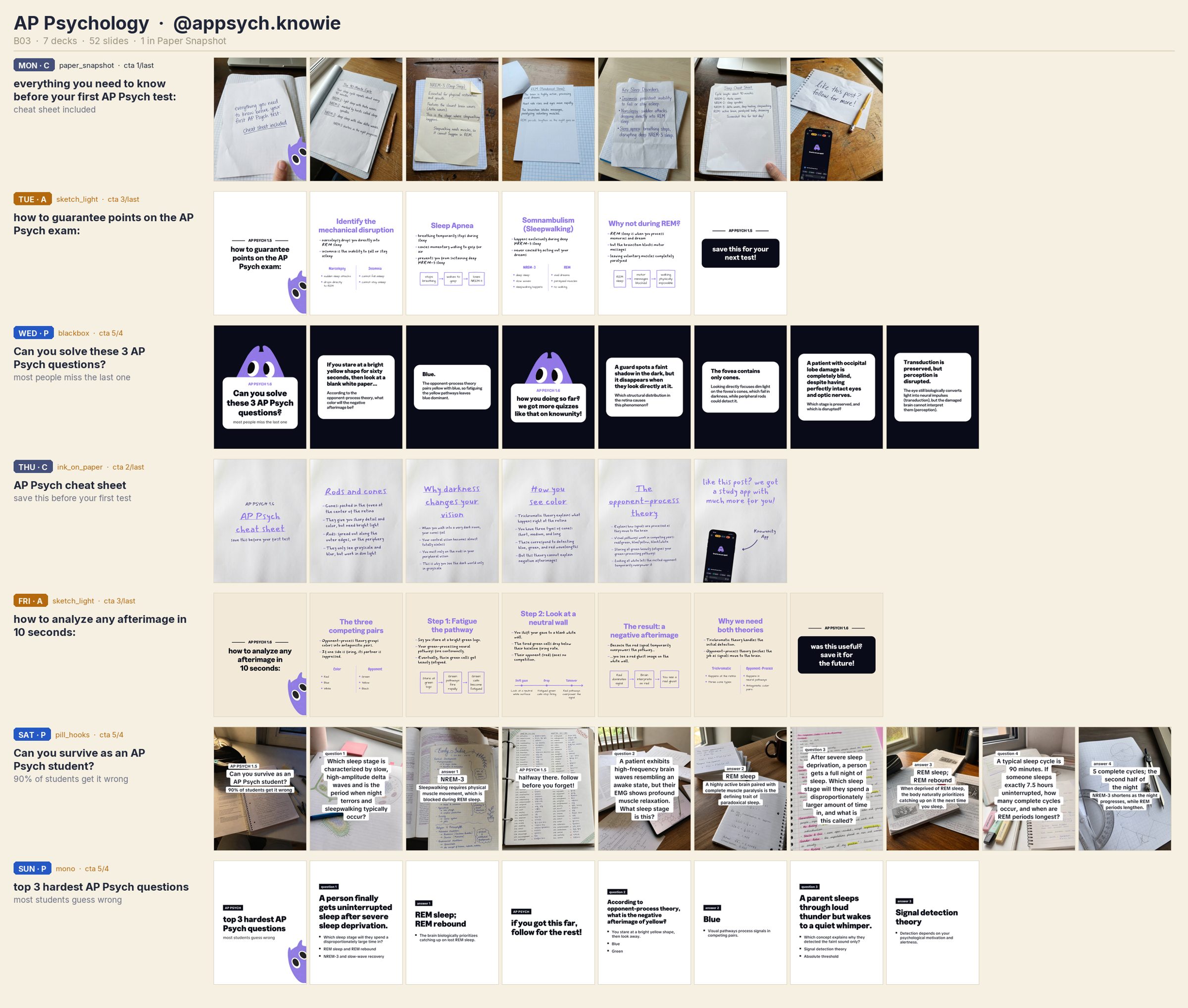
tap the sheet to view it full size, then scroll sideways
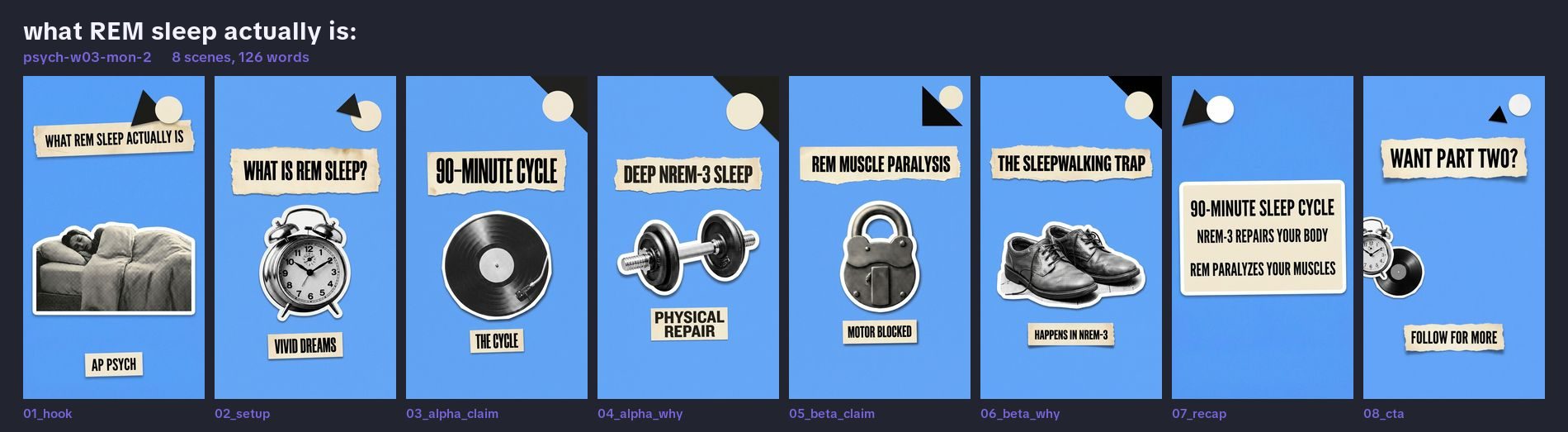
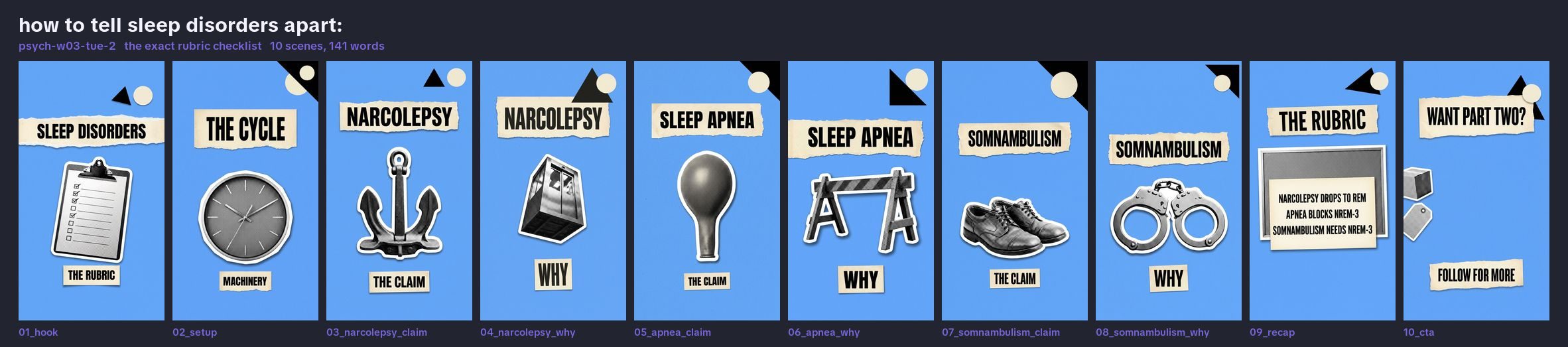
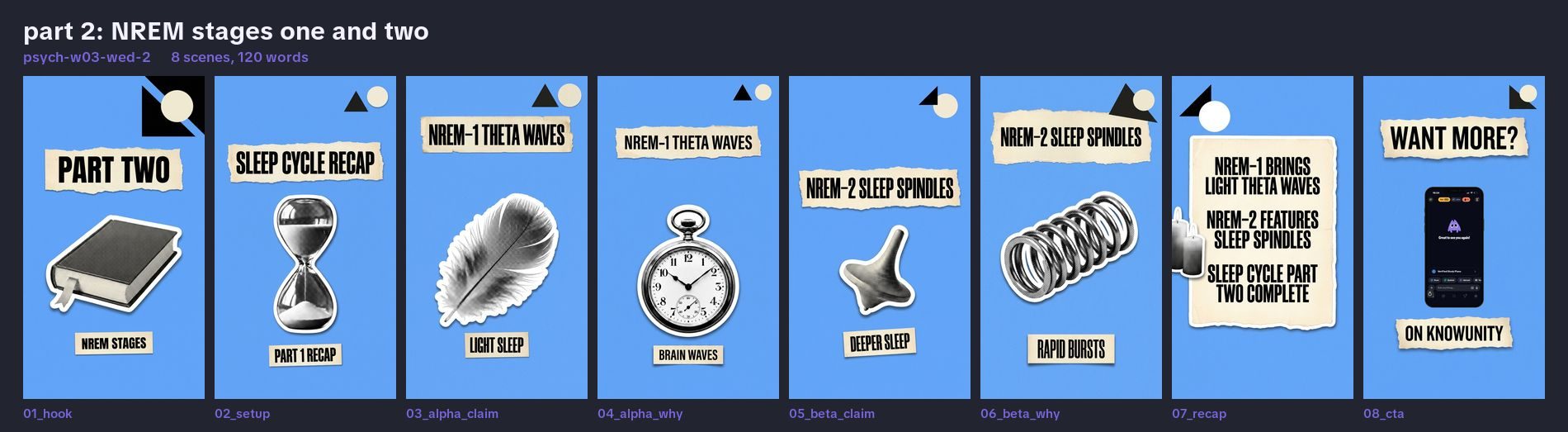
no stills yet
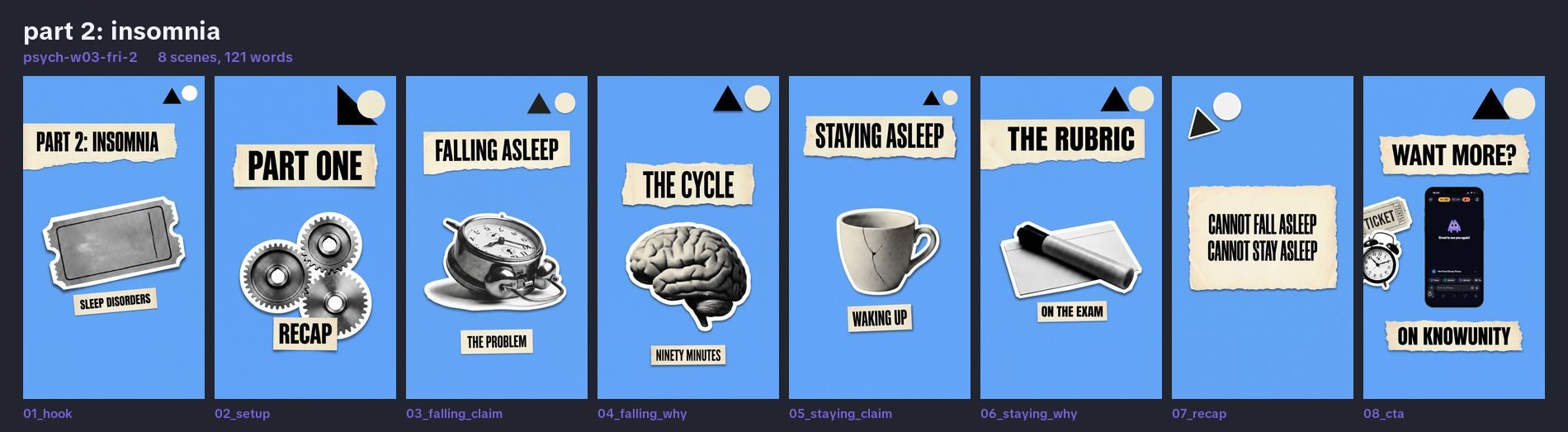
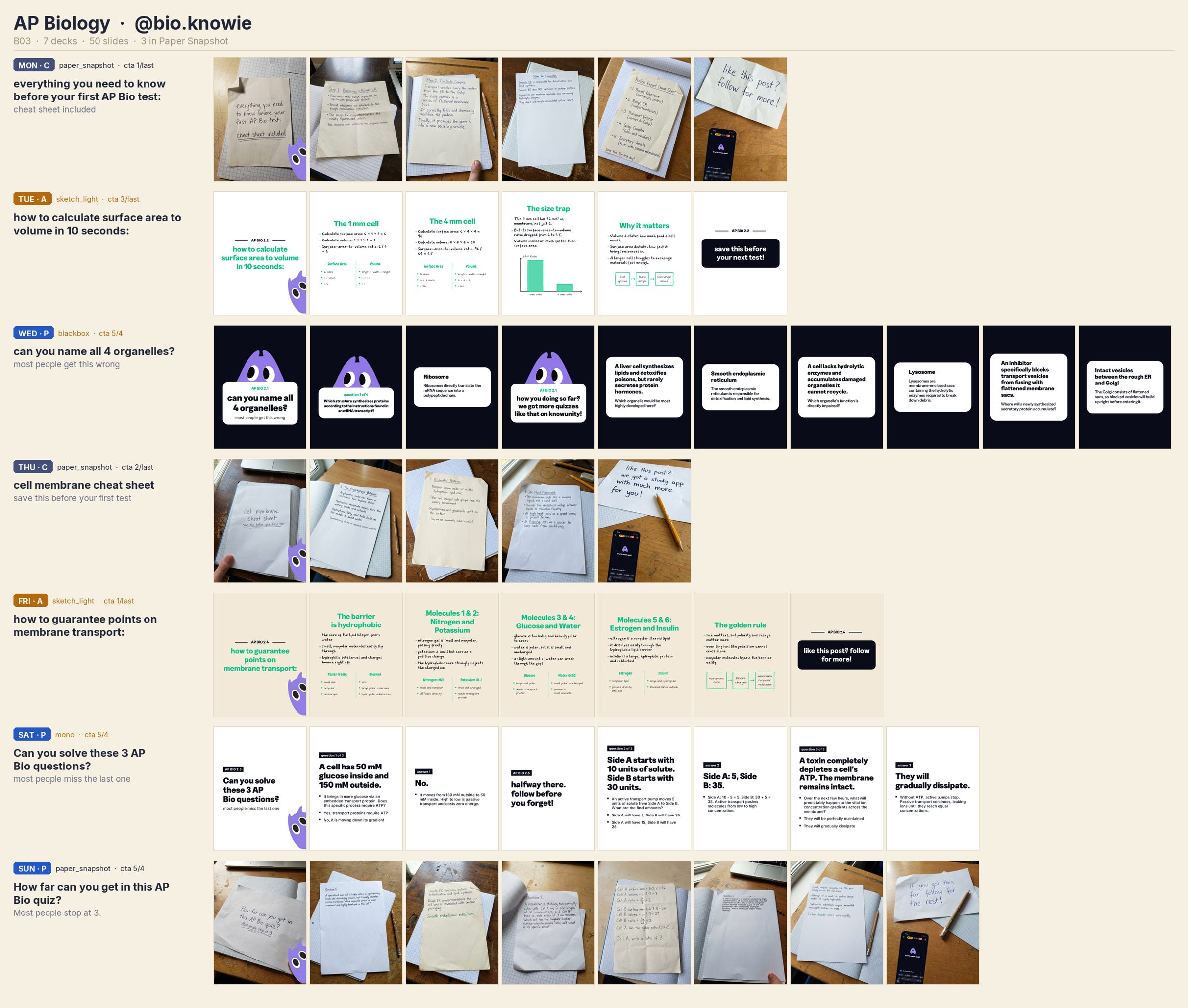
tap the sheet to view it full size, then scroll sideways
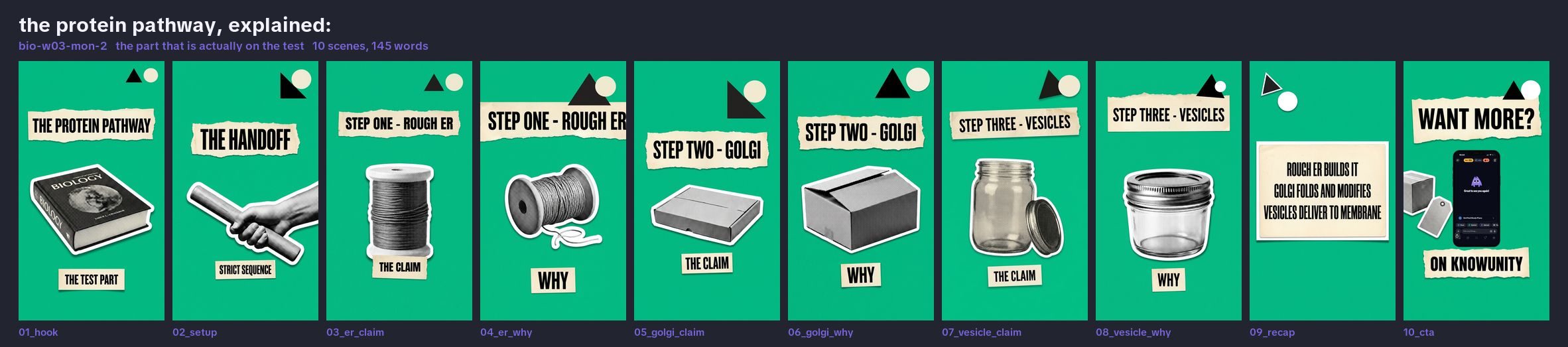
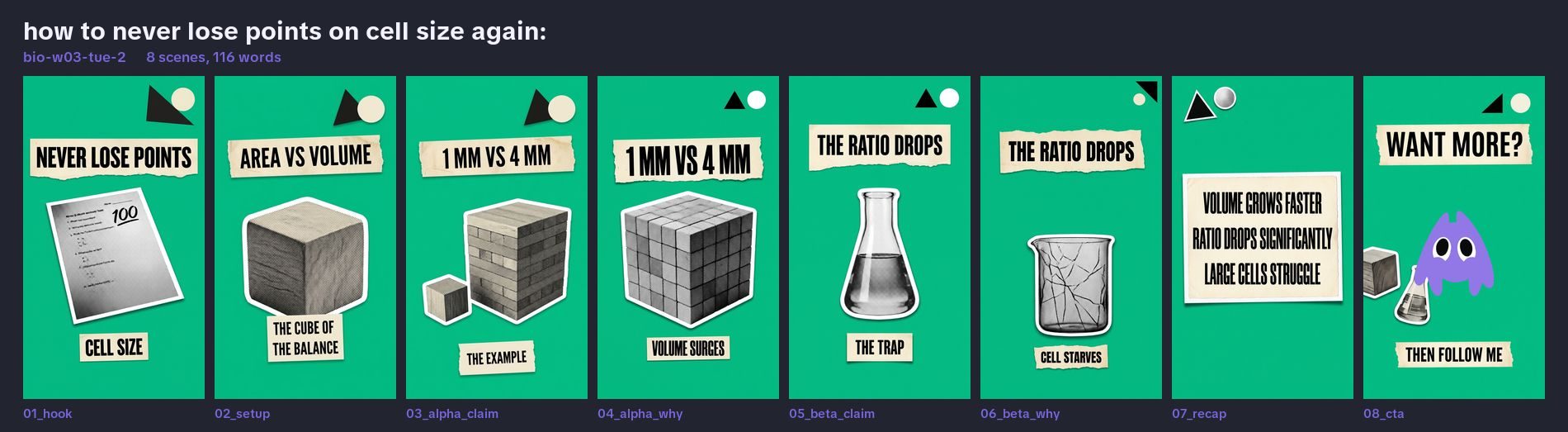
no stills yet
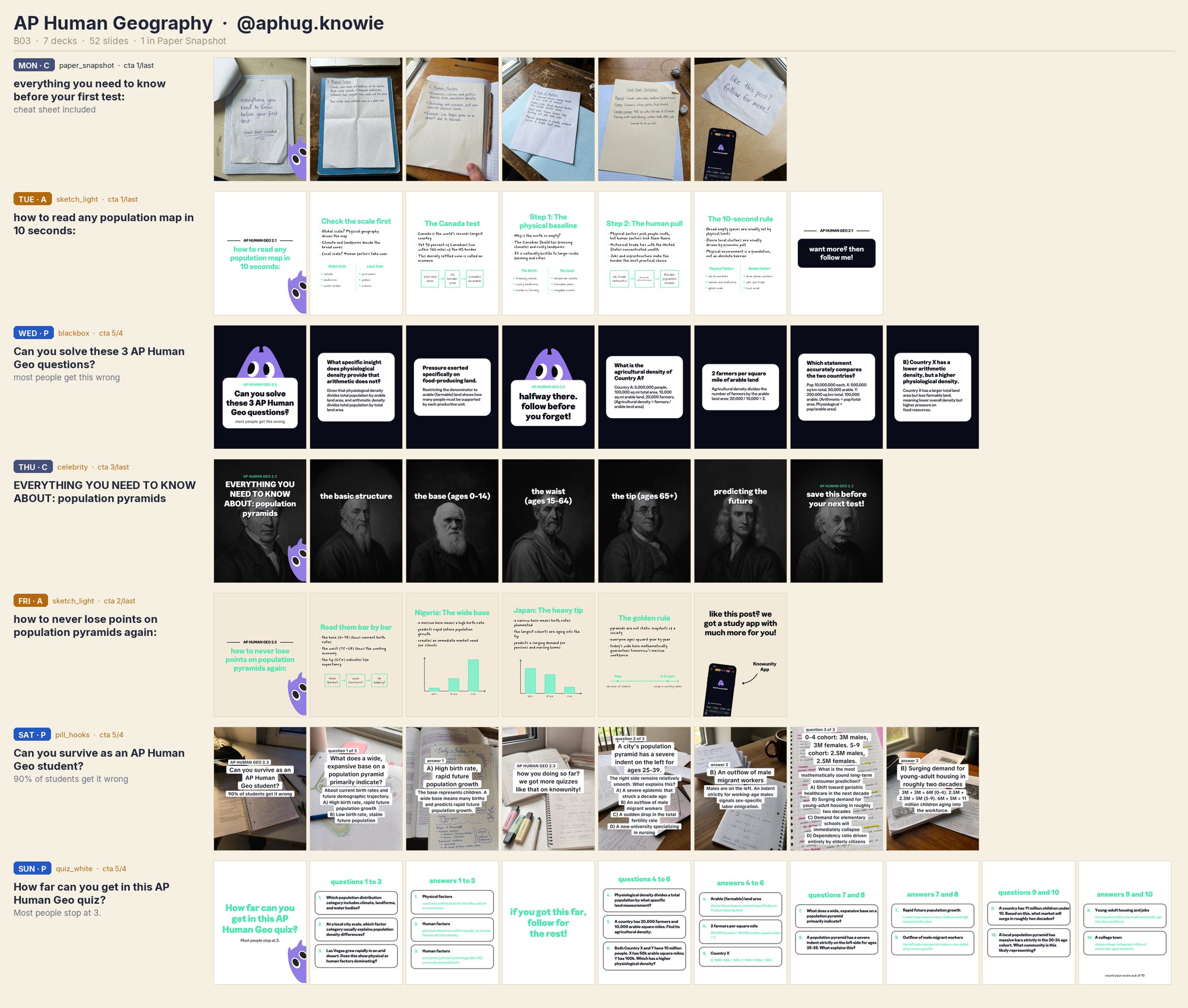
tap the sheet to view it full size, then scroll sideways
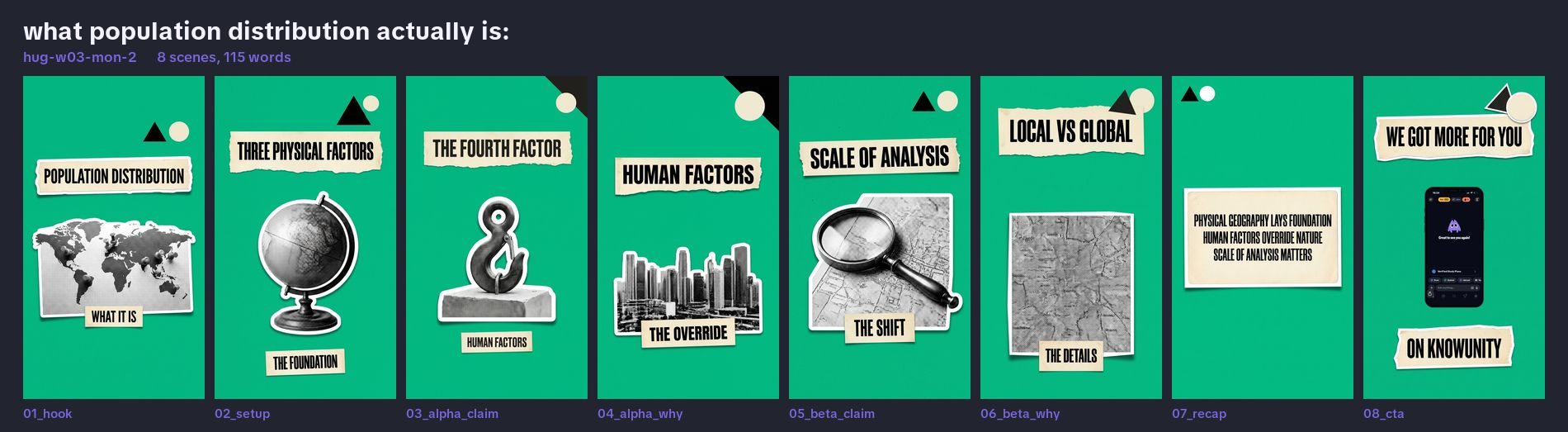
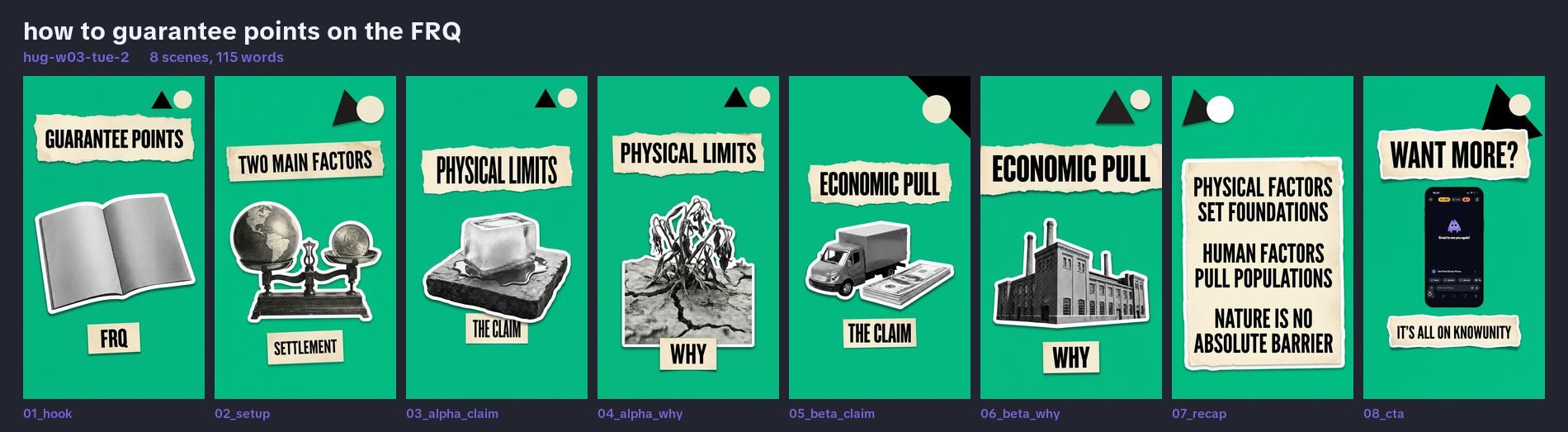
no stills yet
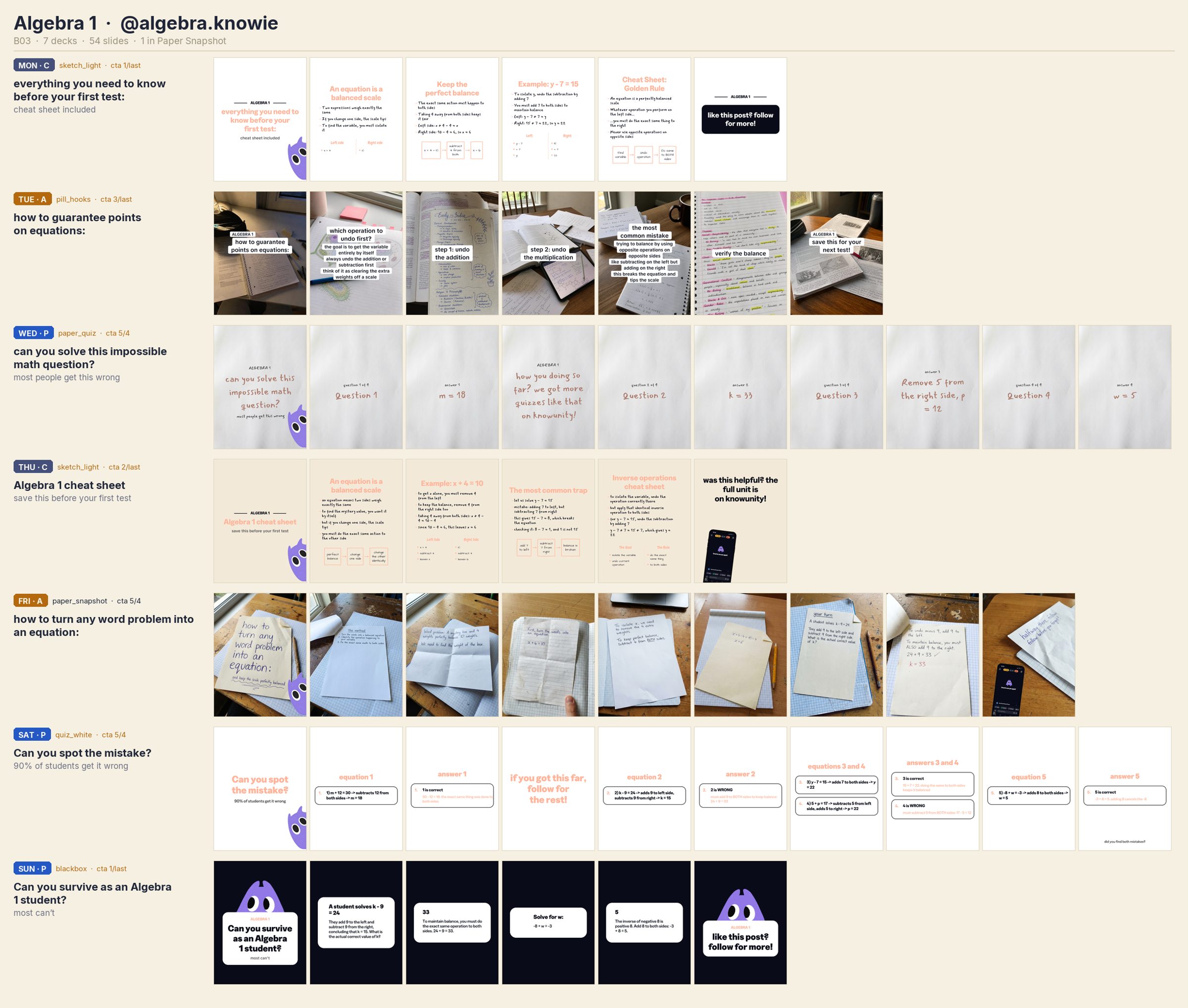
tap the sheet to view it full size, then scroll sideways
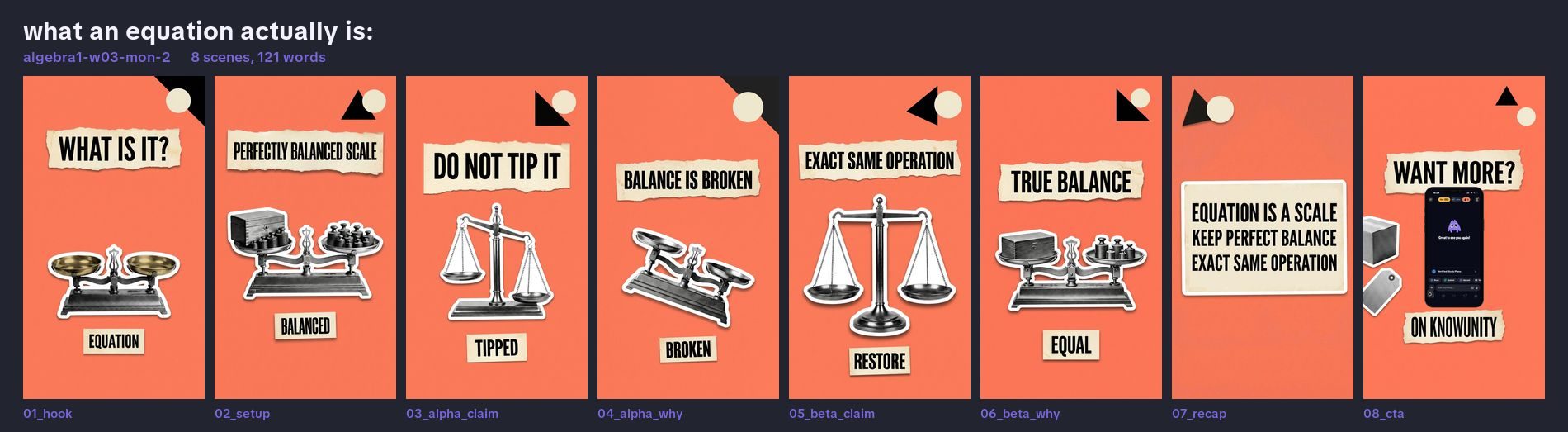
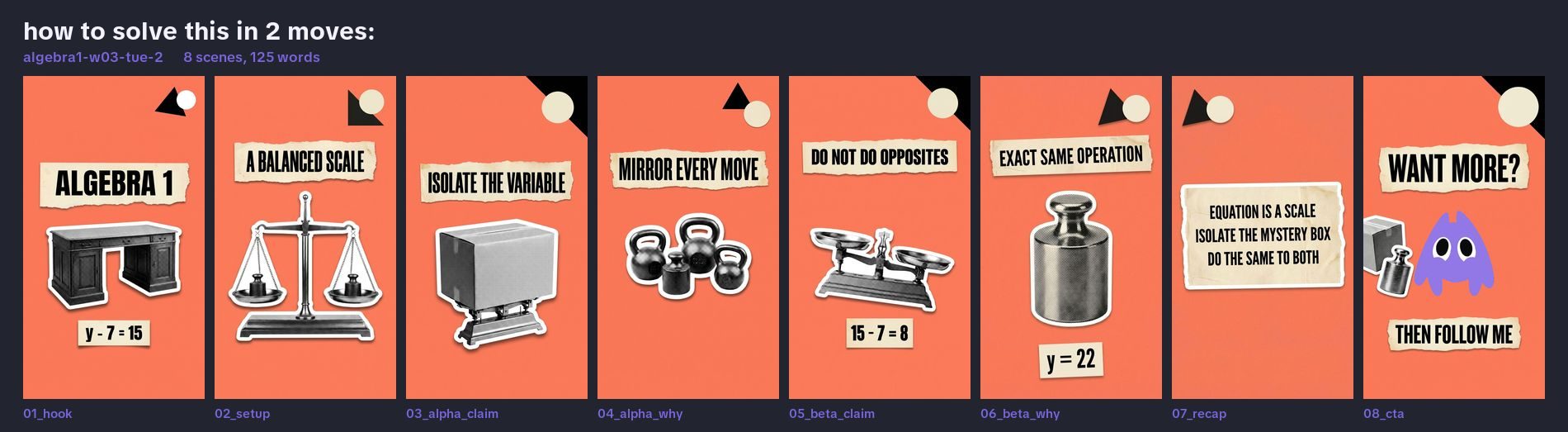

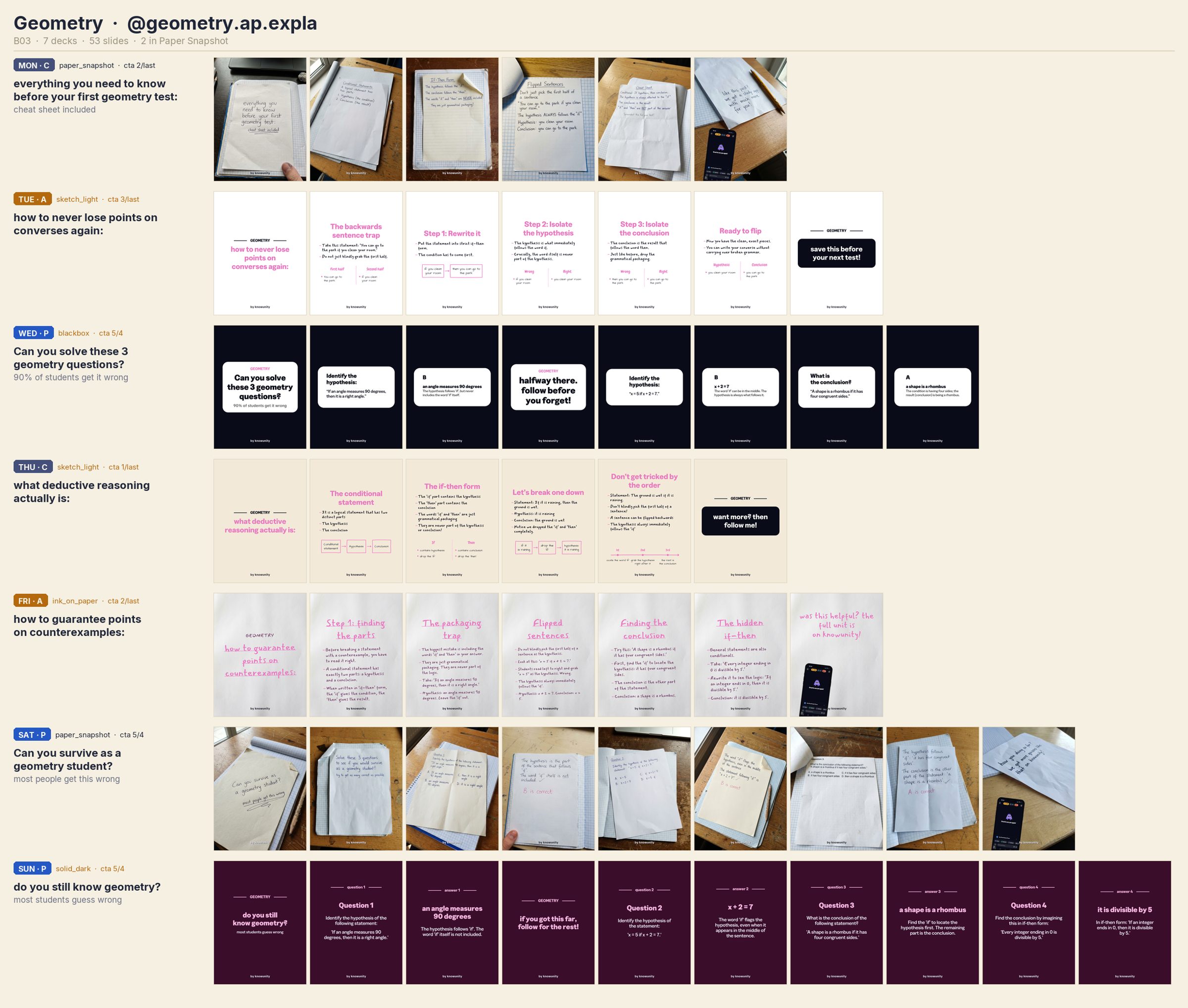
tap the sheet to view it full size, then scroll sideways
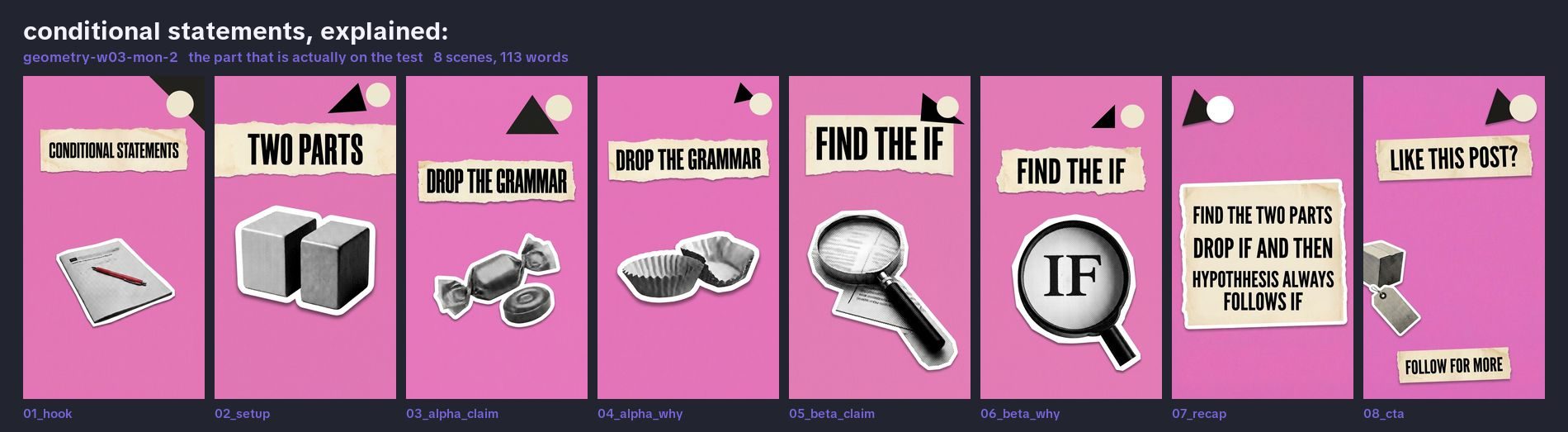
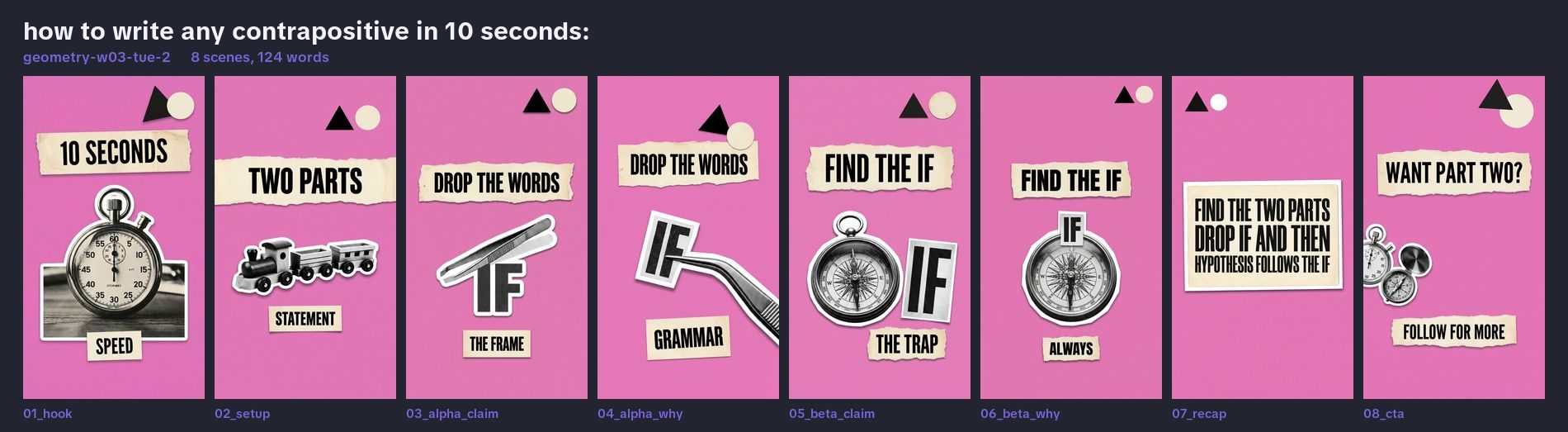

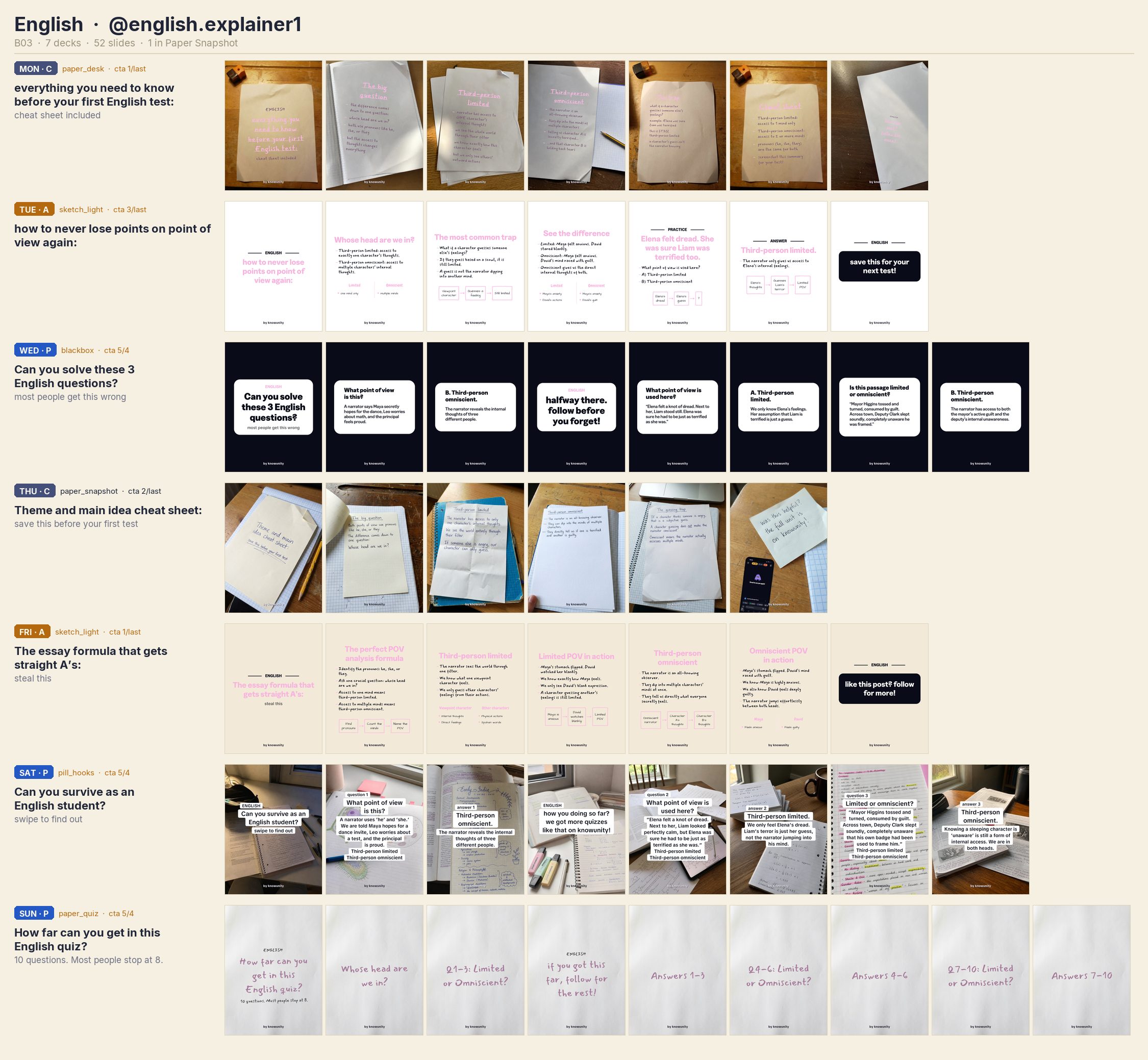
tap the sheet to view it full size, then scroll sideways
no stills yet
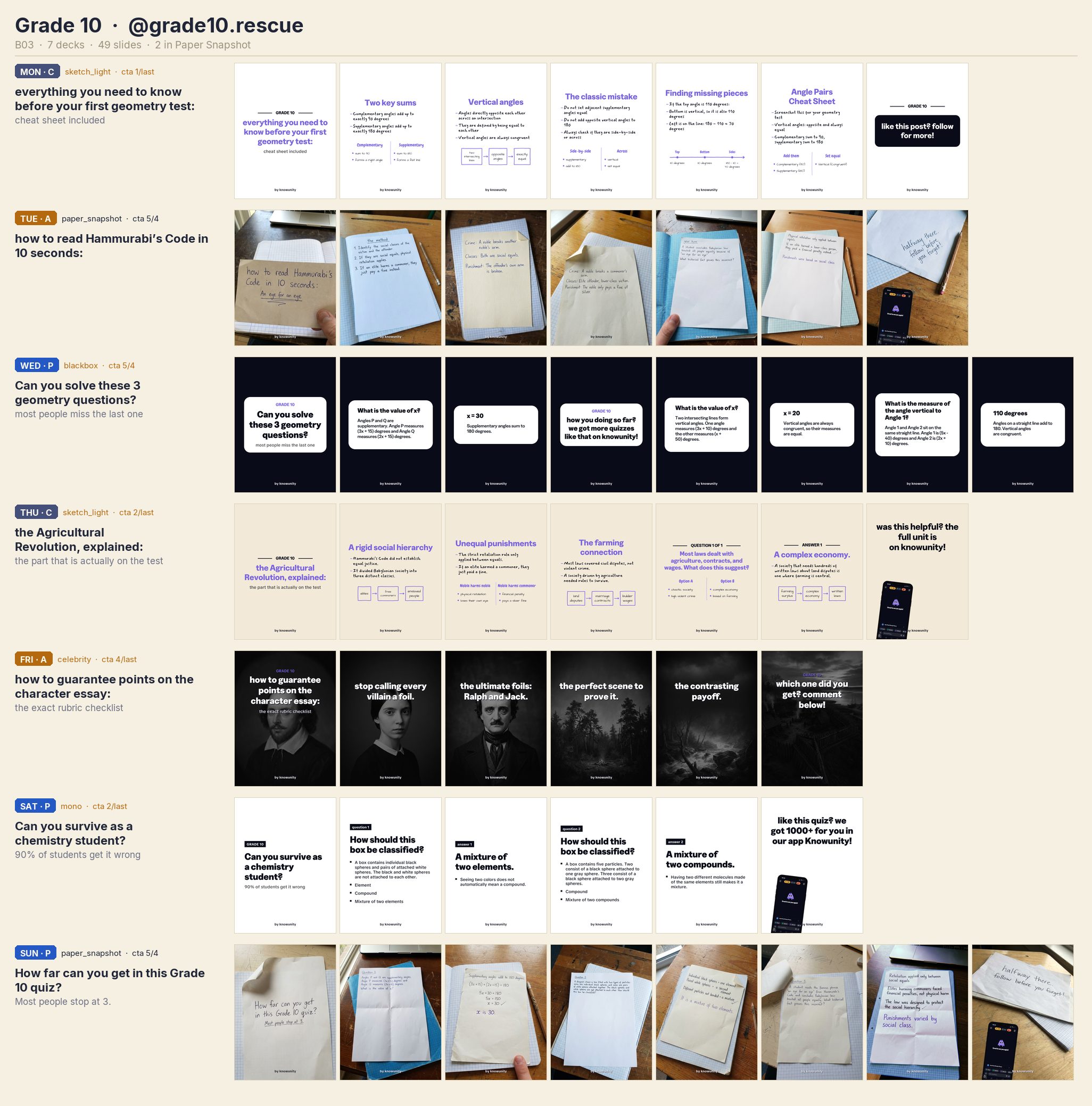
tap the sheet to view it full size, then scroll sideways
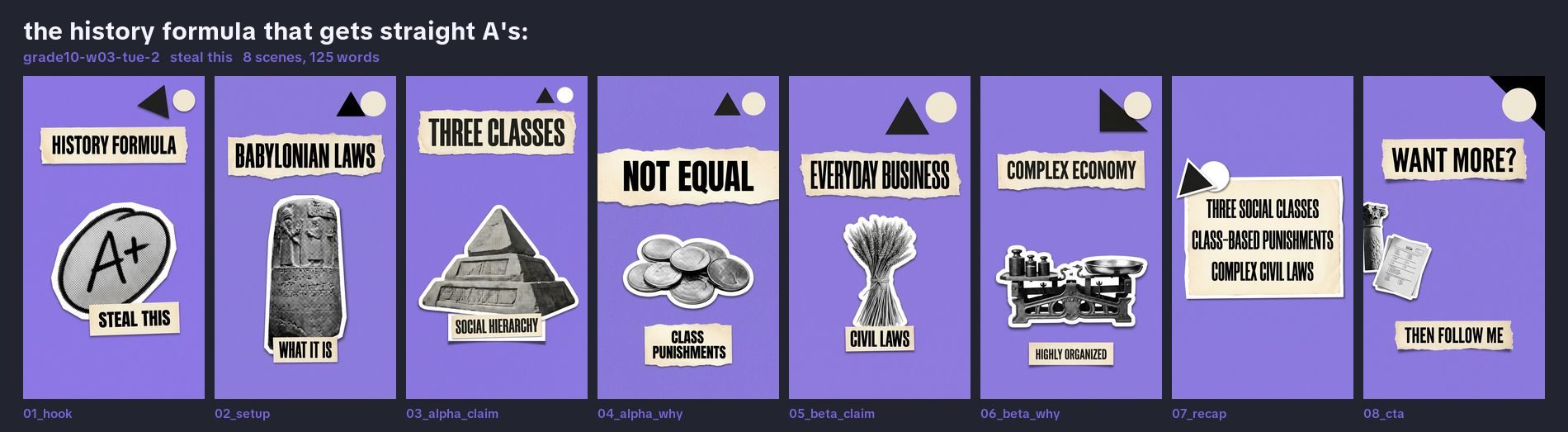
no stills yet
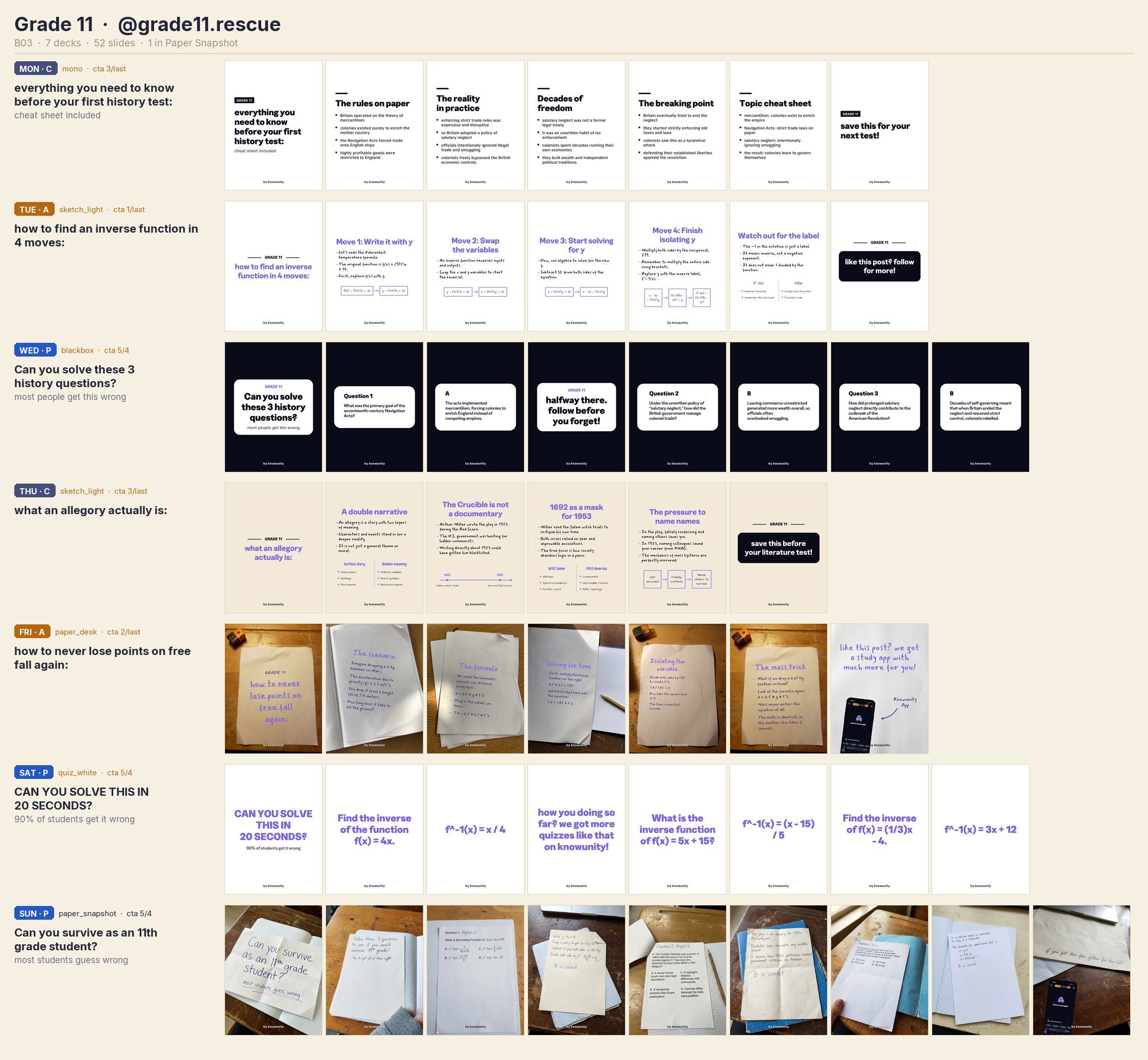
tap the sheet to view it full size, then scroll sideways
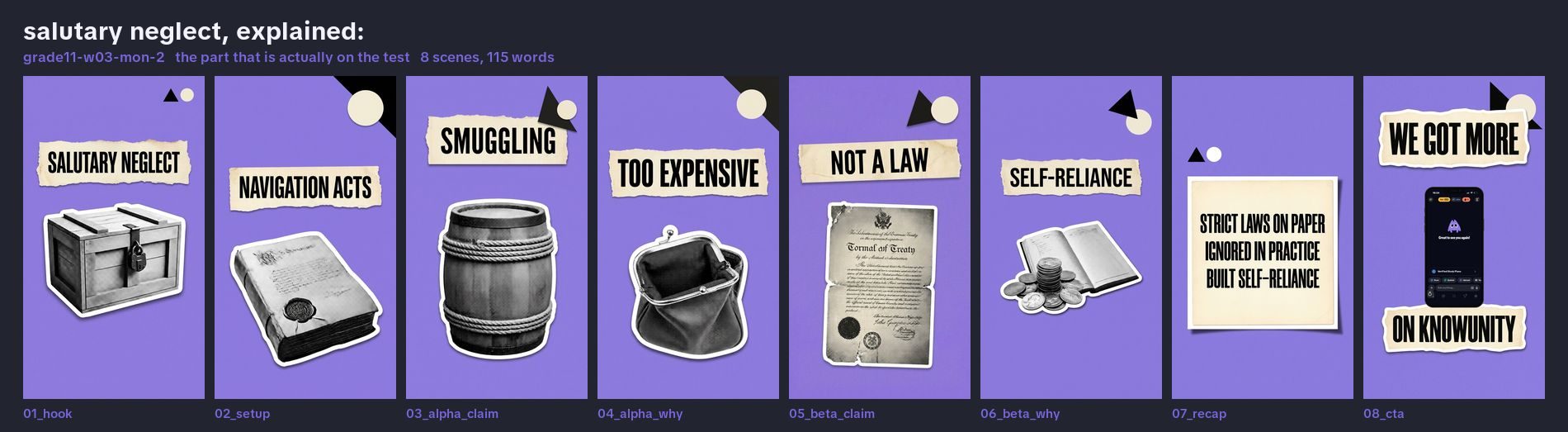
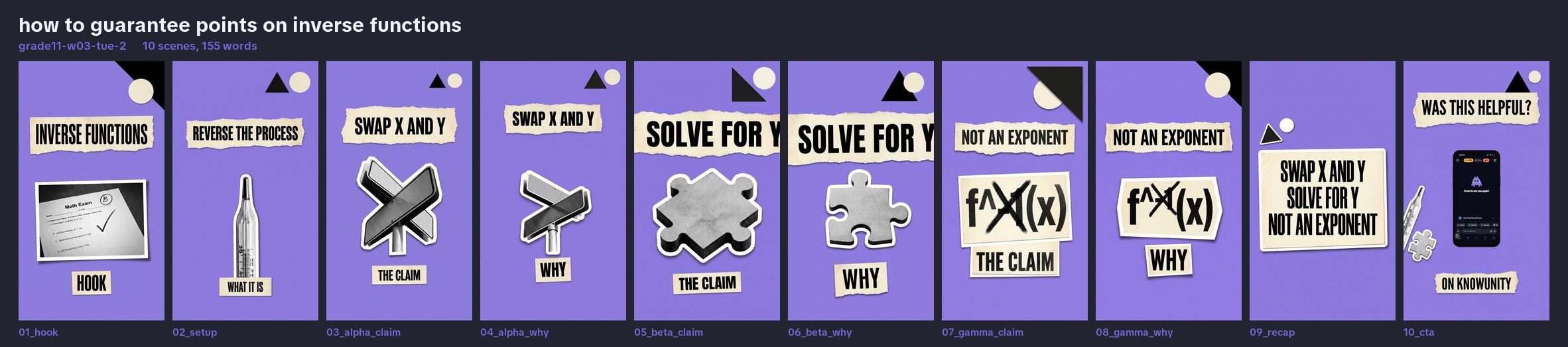

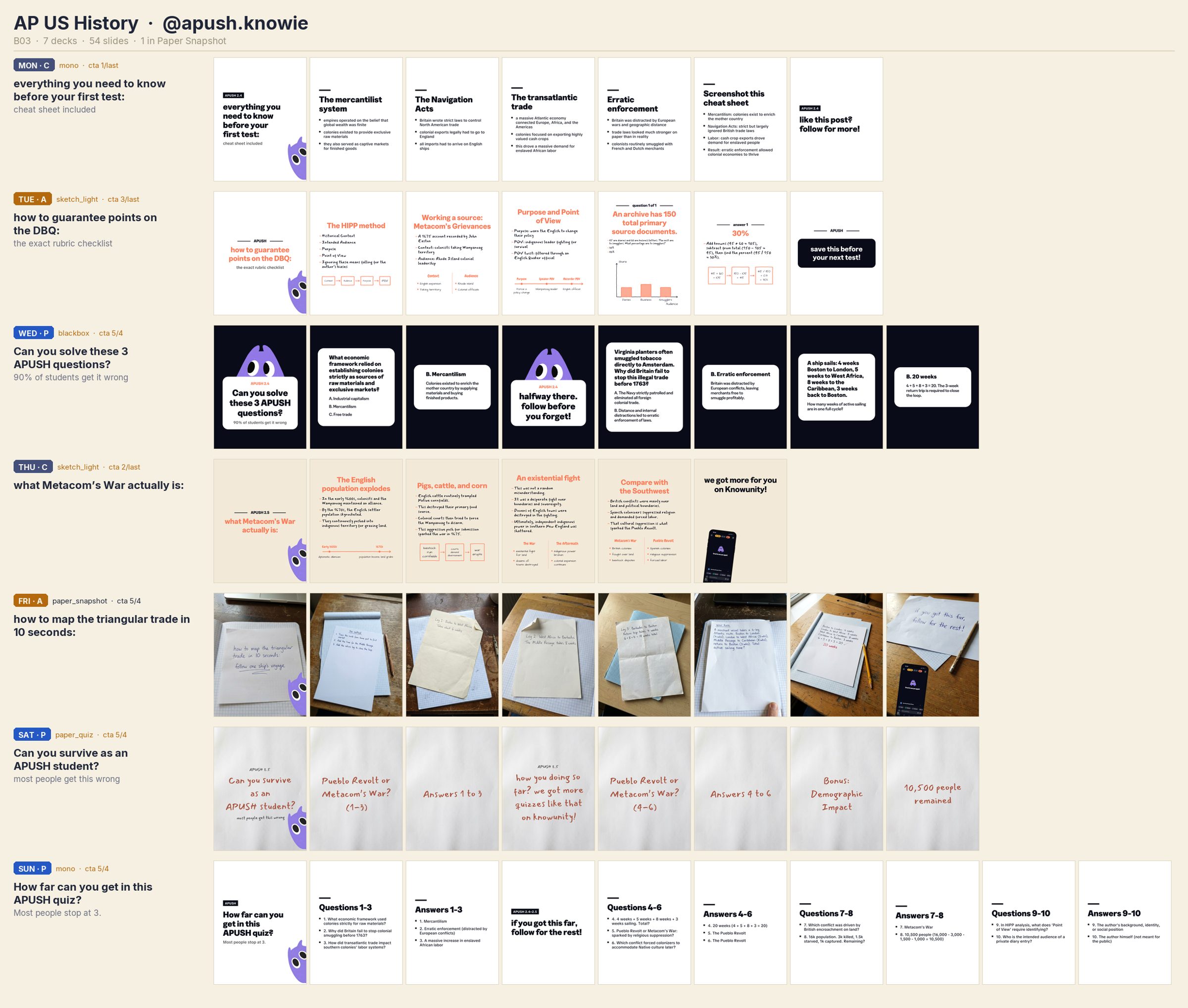
tap the sheet to view it full size, then scroll sideways
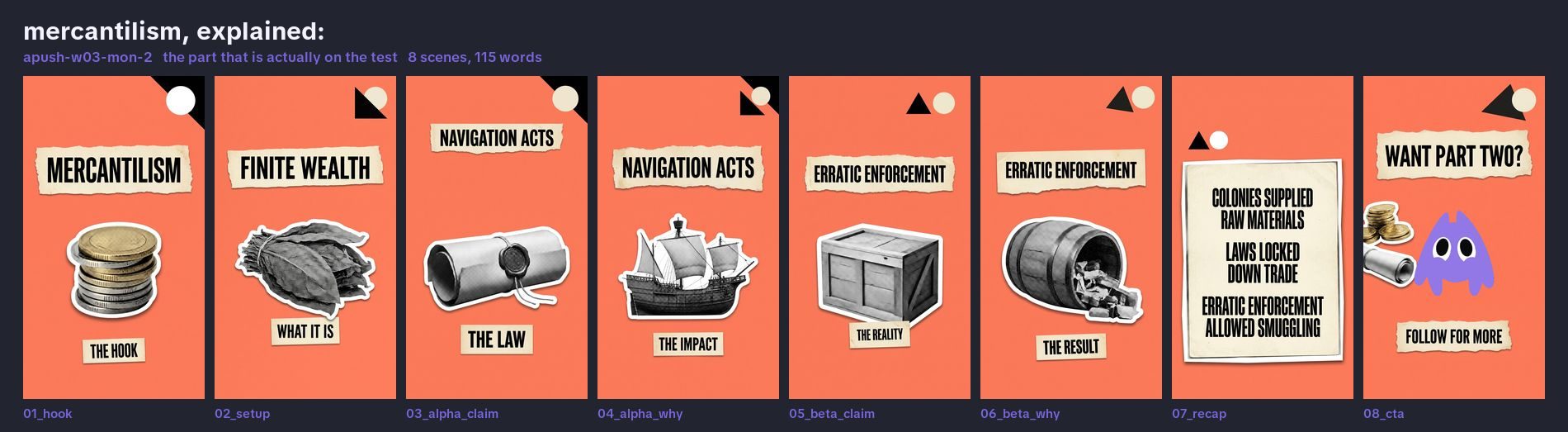
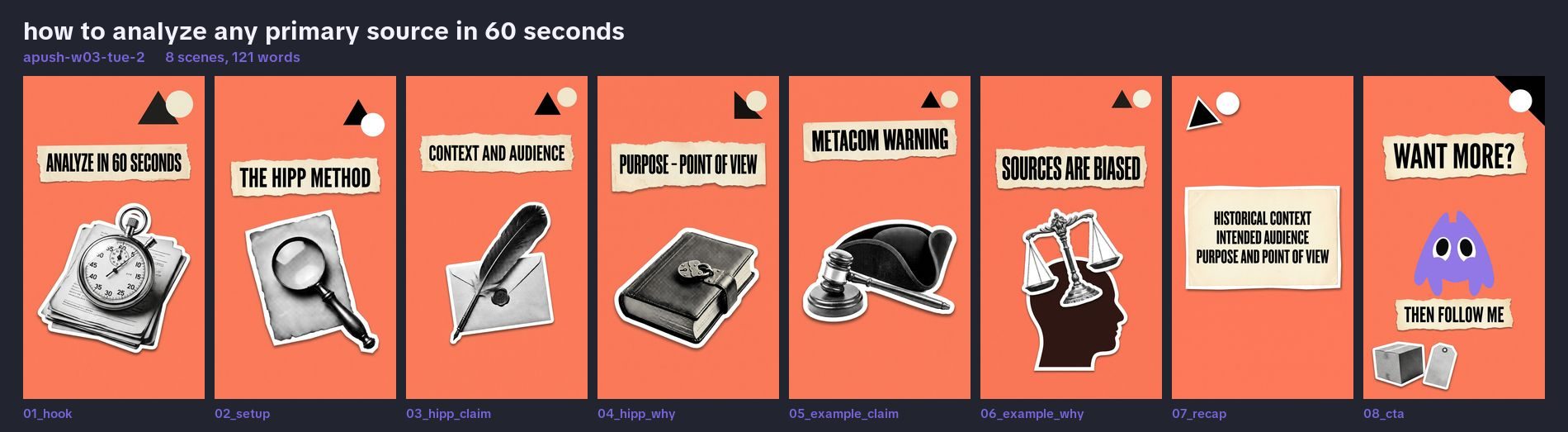

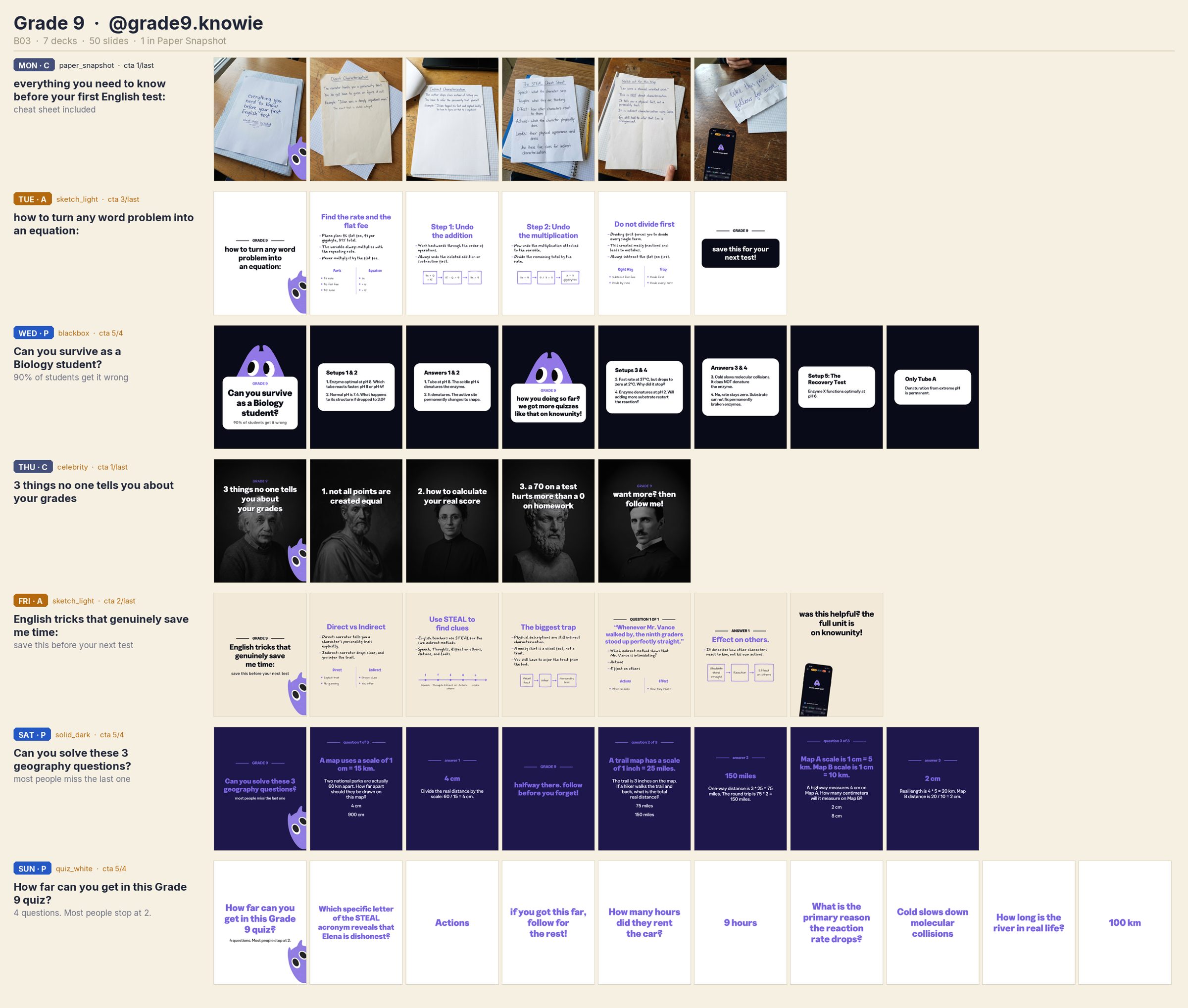
tap the sheet to view it full size, then scroll sideways